At its heart, a Data Processing Agreement (DPA) is a legally binding contract that outlines the rules for handling personal data. It’s signed between a data controller (your client) and a data processor (that’s you). Think of it as the foundational document for dpa data protection—an absolute must-have for any B2B startup that touches customer data, especially under regulations like GDPR, ISO 27001, or SOC 2.
Without a solid DPA, you’re not just non-compliant; you're actively losing deals.
Why a DPA Is Your Most Important Sales Tool

For startups and SMBs, the sales cycle is an obstacle course, and the security review is the final, toughest hurdle. When a potential enterprise customer asks for your DPA, they're not just ticking a box. They're stress-testing your company’s maturity. A flimsy, generic, or—worst of all—non-existent DPA is an immediate red flag that stalls deals, triggers endless security questionnaires, and kills trust before it can form.
On the flip side, presenting a solid, well-crafted DPA from the start transforms a compliance headache into a powerful sales asset. It sends a clear message: you’re a professional, trustworthy partner who takes data protection seriously. This one document becomes a key differentiator, speeding up due diligence and proving to sophisticated buyers that you’re ready for enterprise-level business.
Controller vs Processor: The Core Relationship
To master DPAs, you must understand the two central roles. This distinction is the bedrock of modern data protection law and compliance frameworks like ISO 27001 and SOC 2.
- The Data Controller: This is your client. They own the personal data and determine the purposes and means of processing it. They decide why the data is being collected and, at a high level, how it should be handled.
- The Data Processor: This is your startup. You process that data on behalf of the controller, following their specific, documented instructions. The DPA contains those instructions.
Analogy: Imagine your client (the controller) is an architect who designs a house, detailing every requirement in a set of blueprints. Your company (the processor) is the builder they hire. Your job is to construct that house exactly as the blueprints dictate—no more, no less. The DPA is that legally binding set of blueprints.
This framework makes accountability crystal clear. The controller is legally obligated to work only with processors who provide "sufficient guarantees" of their security measures. Building concepts like privacy by default into your service shows this commitment. A rock-solid DPA is the tangible proof that accelerates the sales process and gives you an instant credibility boost.
Why You Can’t Afford to Ignore Data Processing Agreements
A Data Processing Agreement isn't just administrative paperwork; it's a critical legal shield required by powerful international data protection laws. For any startup handling customer data, overlooking the DPA is a massive gamble that can bring your growth to a screeching halt and jeopardize compliance certifications like ISO 27001 or SOC 2.
The main driver is the General Data Protection Regulation (GDPR). To understand your duties, you must know the core rules, like those in the GDPR regulations. Specifically, Article 28 of the GDPR is unambiguous: a data controller (your customer) is legally required to only engage data processors (that’s you) who can guarantee they’ll protect the data properly.
That guarantee isn't a handshake deal—it’s formalized in a DPA, the binding contract that proves you have your act together.
The Real-World Cost of a Weak DPA
Getting this wrong isn't just a compliance issue; it’s a direct hit to your revenue and reputation. The risks are real and can cripple your business. Without a solid agreement, you're leaving your company exposed to severe consequences.
Here’s what’s really at stake:
- Hefty Regulatory Fines: Under GDPR, penalties are staggering—up to €20 million or 4% of your annual global turnover, whichever is higher. Regulators don't hesitate to use these powers.
- Lost Sales Deals: Enterprise buyers won't sign a deal without a robust DPA. A weak or missing agreement is an immediate disqualifier in their procurement and vendor risk assessment process. This is a common pain point that kills deals for unprepared startups.
- Operational Chaos: Imagine a data breach occurs without a clear DPA. The result is a messy legal nightmare, lengthy investigations, and even forced shutdowns that stop you from serving customers.
Think of a DPA as your armor. It clearly defines your responsibilities and, just as importantly, sets the boundaries of your liability. Without one, you’re not just breaking the law; you’re leaving your business financially and reputationally exposed in a world that demands proof of data security. A solid DPA isn't an expense—it's an investment in your company's credibility and survival.
The Non-Negotiable Clauses Your DPA Must Contain
Think of a DPA as the blueprint for how you protect your client's most sensitive asset: their data. A generic, copy-pasted template won't survive a serious security review. To be effective and close deals faster, your DPA needs to be a precise reflection of your services, security measures, and commitment to compliance frameworks like ISO 27001 or SOC 2.
A solid DPA provides clarity and legal cover, acting as concrete proof of your dedication to robust data protection. It’s built on several key clauses. Overlook any of these, and you’re creating a compliance headache that will block sales and expose your business to risk.
Defining the Scope and Following Instructions
First, your DPA needs to set the scene. This clause defines the "what, who, and why" of the data processing. It must clearly spell out the types of personal data you'll handle (names, emails, IP addresses), who the data belongs to (your client’s customers), and the purpose and duration of the processing. This is your official mandate.
Most importantly, this section must state that you will only process data based on the documented instructions from your client (the data controller). This is a cornerstone of GDPR Article 28 and is what officially defines your role. It prevents you from using client data for your own purposes and tightly defines your responsibilities.
Security Obligations and Concrete Measures
This is where you prove your worth. The security clause details the technical and organizational measures (TOMs) you have in place to safeguard data. Vague promises about "state-of-the-art security" are red flags for experienced buyers. You must be specific.
Your DPA should outline or reference your security controls, which often align with frameworks like ISO 27001 or SOC 2. This includes:
- Encryption for data in transit and at rest.
- Strict access controls to ensure only authorized personnel can access the data.
- A program of regular security testing and vulnerability scanning.
- Resilience and backup systems to ensure business continuity and data availability.
This clause is your direct answer to the client's need for "sufficient guarantees." Expect it to be the most scrutinized section of the entire agreement, often cross-referenced with your security questionnaire responses.
Navigating the World of Subprocessors and International Transfers
Let's be realistic—few startups handle every piece of data processing themselves. This is where subprocessors (your vendors, like AWS or Stripe) come in. Your DPA must have clear rules governing their use. A key requirement is that you won’t engage a new subprocessor without getting your client's prior consent, either specific approval or general authorization with a right to object.
A strong DPA creates a transparent data supply chain. It commits you to keeping an up-to-date list of your subprocessors and, critically, ensures you have legally binding contracts with them that pass down the same data protection obligations you owe to your client.
Furthermore, if any data leaves the EU or UK, this section must detail the legal safeguards you're using. Typically, this means implementing Standard Contractual Clauses (SCCs). This demonstrates how you ensure data remains protected across borders—a massive pain point and a common deal-breaker for enterprise clients. Getting this wrong can stop a promising partnership dead in its tracks.
Navigating Subprocessors and Global Data Transfers
In today's SaaS world, no startup operates in a vacuum. We rely on third-party vendors—or subprocessors—for everything from cloud hosting (AWS) to analytics (Segment). While this is standard practice, for your clients, it means their data’s potential exposure grows with every vendor you add.
Think of it as a supply chain. Every subprocessor is another link, and your clients are legally required to ensure the entire chain is secure. This is why enterprise legal teams will scrutinize your subprocessor list. For a startup, a messy or unclear vendor management process can halt a promising deal for weeks. Your DPA is the tool that brings order to this chaos, creating a clear, contractually sound framework for managing these third parties.
This is where the DPA builds critical trust, laying out the rules of engagement step-by-step.
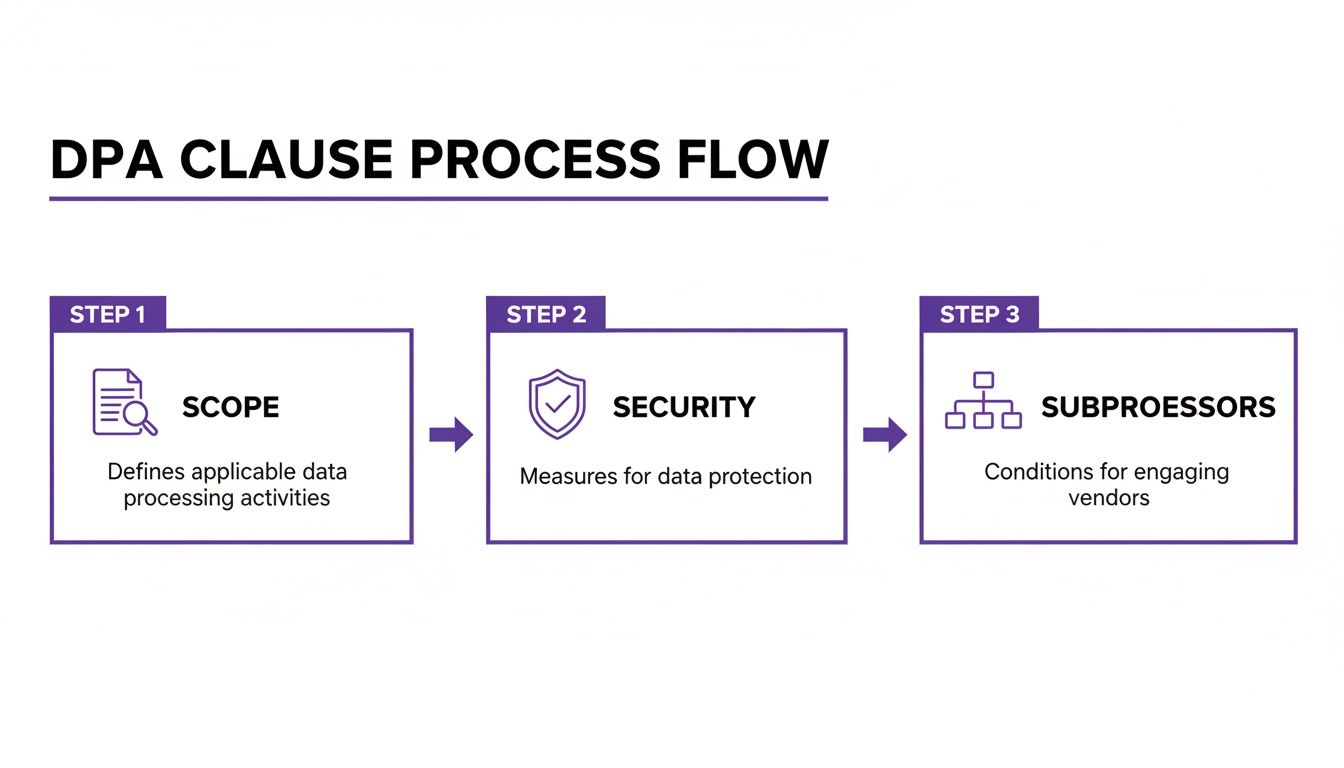
As you can see, defining the scope and security measures first provides the foundation needed to properly manage subprocessors and create a coherent data protection strategy.
Building a Compliant Subprocessor Framework
To satisfy enterprise clients, your DPA must show you have tight control over your entire data supply chain. It's not enough to just list names; you need to demonstrate a clear, enforceable process for managing them. This is the core of effective Third-Party Risk Management (TPRM).
Your DPA must spell out a few key commitments:
- Obtain Prior Consent: You must get your client's permission before engaging a new subprocessor to handle their data. This can be specific approval or a more common general authorization where you provide a list and give them the right to object to new additions.
- Maintain an Up-to-Date List: Transparency is non-negotiable. You must maintain a current list of every subprocessor touching your client's data. This is a common requirement in security questionnaires and SOC 2 audits.
- Flow Down Obligations: The data protection promises you make to your client must be legally passed down to your subprocessors. This means having a binding written agreement with each vendor that mirrors the obligations in your DPA.
Demystifying International Data Transfers
Things get even more complicated when data crosses borders, especially when moving personal data out of Europe. Your DPA absolutely must specify the legal mechanism you’re using to guarantee that data receives EU-level protection, no matter where it's processed.
For most SMBs and startups, the solution is using Standard Contractual Clauses (SCCs). These are pre-approved legal contracts from the European Commission that provide a legitimate basis for international data transfers.
Including SCCs in your DPA, typically as an appendix, is a must-have for any client with European operations. It’s a clear signal that you understand global compliance. Overlooking international transfers is a classic deal-breaker because it leaves your client exposed to massive regulatory risk. Getting this right in your DPA removes a huge roadblock from your sales process.
The Real-World Costs of Non-Compliance in France
It’s one thing to talk about data protection obligations in theory, but what does getting it wrong actually cost a growing business? In France, the answer is simple: a lot. A weak DPA isn't just a gap in your paperwork; it's a direct threat to your financial health and ability to do business, policed by one of Europe's most proactive regulators.
The French data protection authority, the Commission Nationale de l'Informatique et des Libertés (CNIL), is well-known for its strict enforcement. For any business operating in France or handling the data of French residents, underestimating the CNIL is a huge mistake. Their track record makes it clear that solid compliance is non-negotiable.
Here is the official homepage for the CNIL, the authority responsible for enforcing data protection law in France.
This site is the go-to source for official guidance, news on recent enforcement actions, and compliance tools. It's an indispensable bookmark for any company under French jurisdiction.
The Financial Impact of CNIL Enforcement
Looking at the penalties handed out by the CNIL, you can see a clear and serious trend. Between 2019 and 2025, the authority issued several massive sanctions, proving it isn't afraid to use the full extent of its GDPR powers. For example, the CNIL hit Criteo with a €40,000,000 fine for invalid consent practices and fined Orange €50,000,000 for failing to be transparent.
These aren't just isolated, headline-grabbing numbers. They're backed by consistent, lower-level enforcement, with fines ranging from tens of thousands to nearly a million euros for everything from poor security measures to not telling people about a data breach. The pattern shows that companies of all sizes are being watched, and the financial stakes are very real. To get a better sense of the bigger picture, you can read more about recent data protection enforcement trends.
The message from French regulators is unmistakable. Investing in proper DPA management, lawful data processing, and strong technical measures is not a business expense—it is an essential investment to avoid crippling fines and maintain your ability to operate within the crucial EU market.
But the consequences don't stop at fines. The CNIL can also order companies to change how they operate, temporarily halt their data processing, or even publicly announce their non-compliance, which can do lasting damage to a company's reputation.
Keeping detailed internal records is one of your best lines of defence. Our guide on how a GDPR Register Generator can help you get your processing activities in order is a great place to start. For any business with its eyes on the French market, the real-world costs make robust data protection an absolute strategic priority.
How to Automate DPA Management and Accelerate Deals
For fast-growing SMBs and startups, manually managing Data Processing Agreements is a major drag on operations. It’s a painful cycle: endless back-and-forth drafting, redlining, and tracking DPA versions via email. This process consumes precious time from your legal, security, and sales teams, often grinding the sales cycle to a halt.
This isn't just an administrative headache; it's a direct obstacle to closing deals and scaling your business. Every day spent haggling over DPA clauses is another day of delayed revenue, creating a significant pain point for your go-to-market teams.
This is where compliance automation platforms come in. They transform this painful chore into a streamlined workflow that helps you close deals faster, prove your security posture, and tackle compliance frameworks like ISO 27001, NIS 2, DORA, and SOC 2.

From Manual Effort to Smart Automation
Imagine replacing chaotic spreadsheets and email threads with a centralized platform. You can generate DPAs from a single source of truth, maintain a unified record of your security measures, and even automate your Record of Processing Activities (RoPA). When connected to your security questionnaire workflows, you create a powerful, efficient compliance machine.
Instead of starting from scratch with every client, a compliance platform can generate an accurate, tailored DPA in minutes. This shift from manual grind to smart automation doesn't just ensure accuracy; it signals a high level of security maturity that enterprise customers demand.
It's also important to look beyond fines. In France, for instance, only about 1.3% of data protection cases end in a financial penalty. Far more often, the CNIL issues corrective orders, forces changes to your data processing, and makes public disclosures that damage your reputation. You can dive deeper into the French data protection landscape on dlapiperdataprotection.com.
Automating your DPA data protection processes helps you avoid these broader supervisory actions and, crucially, keeps your sales cycle moving forward without friction.
Your DPA Questions, Answered
When you're dealing with data protection, a few common questions always pop up, especially for startups and growing businesses. Let's clear up some of the most frequent queries that arise during the sales process.
Do We Genuinely Need a DPA for Every Single Client?
Yes. If you process personal data on behalf of any client subject to regulations like GDPR, a DPA is a legal requirement. It doesn't matter if the client is a small startup or a Fortune 500 company.
Having a standardized, robust DPA ready to go signals that you're a professional and trustworthy partner. It builds immediate confidence and can dramatically speed up your sales cycle by preventing compliance from becoming a last-minute bottleneck that requires painful security questionnaires.
What’s the Difference Between a DPA and a Privacy Policy?
This is a common point of confusion. A Privacy Policy is a public-facing document explaining how you, as a data controller, collect and use personal information from your own website visitors and users.
A DPA, on the other hand, is a private, B2B contract between you (the processor) and your client (the controller). It outlines how you will handle the personal data your client has entrusted to you.
In simple terms: Your Privacy Policy is a public promise to individuals. Your DPA is a legal commitment to another business. They serve completely different functions and audiences.
Can't We Just Grab a Free DPA Template Online?
Using a generic online template is a massive risk. These one-size-fits-all documents rarely reflect your company's specific data processing activities, security measures, or subprocessors. This creates a dangerous compliance gap that will be easily exposed during a security review.
An inaccurate DPA is worse than no DPA at all because it creates a false sense of security. It’s far better to work with legal counsel or use a specialized compliance platform to generate an agreement that accurately represents your operations. A tailored DPA will stand up to scrutiny, protect your business, and help you close deals faster.
Ready to stop letting security reviews and compliance questionnaires slow you down? Compli.st is an AI-powered platform that helps startups and SMBs automate DPA management, fly through security reviews, and achieve compliance with frameworks like ISO 27001, NIS 2, DORA, and SOC 2. Turn compliance from a bottleneck into a competitive advantage. Visit https://www.compli.st to learn how you can accelerate your sales cycle.