If you're finding NIST SP 800-53 overwhelming, you’re in good company. For SMBs and startups, the key is to see it not as a rigid checklist, but as a catalogue of security best practices to win bigger clients and streamline compliance with frameworks like ISO 27001, SOC 2, NIS 2, and DORA. Think of it as a playbook of proven strategies to turn security into a competitive advantage.
Understanding the NIST SP 800-53 Framework
NIST Special Publication 800-53 is a detailed set of security and privacy controls developed by the U.S. National Institute of Standards and Technology. While originally for U.S. federal systems, it's now a gold standard in the private sector, especially for B2B companies.
For many startups and SMBs, the first encounter with NIST SP 800-53 is a painful one: a massive security questionnaire from a dream client lands on their desk, putting a high-value deal on ice. This is a common pain point that stalls growth and drains engineering resources.
At its heart, NIST SP 800-53 offers a structured way to manage risk. It groups hundreds of security measures into 20 "control families", covering everything from Access Control and Incident Response to Supply Chain Risk Management. This structure provides a clear blueprint for building a layered defense that protects sensitive data and satisfies enterprise buyers.
Let's break down the essential components of the latest revision, Revision 5.
NIST SP 800-53 at a Glance
| Component | Description |
|---|---|
| Control Catalogue | A comprehensive list of security and privacy controls organised into 20 families. |
| Control Baselines | Pre-defined sets of controls (Low, Moderate, High) recommended for different risk levels. |
| Tailoring Guidance | Instructions on how to customise the baselines to fit a specific organisation's unique needs and risks. |
| Overlay Process | A method to create specialised sets of controls for specific technologies or communities (e.g., cloud, IoT). |
| Supply Chain Risk | A dedicated control family (SR) addressing risks from suppliers and third parties. |
This table gives you a quick snapshot, but the real power of the framework lies in its practical application for your business.
Why It Matters Beyond Government Contracts
Even if you don't sell to the U.S. government, understanding NIST SP 800-53 is a smart move. Large corporations use it as a benchmark for their security programs. When they vet new vendors—especially SMBs and startups—they're looking for alignment with these principles. Demonstrating this alignment can be the difference between a stalled deal and a quick win.
For a growing business, the value of NIST SP 800-53 is building trust. It provides a common language to prove your security posture, turning a major sales blocker into a key differentiator that accelerates deals with enterprise clients.
A Foundation for Broader Compliance
Implementing NIST controls isn’t just about satisfying one demanding customer; it lays a solid foundation for achieving other critical compliance goals. To appreciate this, it helps to understand what a cybersecurity framework is. The good news is that many of the controls in NIST SP 800-53 map directly to other popular standards.
For example, aligning with NIST gives you a huge head start on meeting requirements for:
- ISO 27001: The global standard for information security management.
- SOC 2: Essential for SaaS companies handling customer data.
- NIS 2 & DORA: Critical new regulations for companies operating in the European Union.
For a startup or SMB, this overlap is a game-changer. Instead of starting from scratch for every audit or questionnaire, you can leverage your NIST-aligned program as a single source of truth. This actionable approach saves massive amounts of time, money, and stress.
Understanding the NIST SP 800-53 Control Families
Imagine you’re building a digital fortress to guard your company's data. A real fortress isn't just about high walls; it needs guards at the gate, patrols on the perimeter, lookouts in the towers, and a clear plan for when things go wrong. The NIST SP 800-53 control families bring that same level of organised thinking to your cybersecurity defences.
The entire framework is built around 20 distinct families of controls. Think of these as specialised departments within your fortress, each responsible for a different aspect of security and privacy. For a growing SaaS business, getting to grips with these families is the first step toward transforming compliance from a headache into a real competitive advantage.
This diagram gives you a bird's-eye view of how the framework is organised, showing its main security and privacy branches.
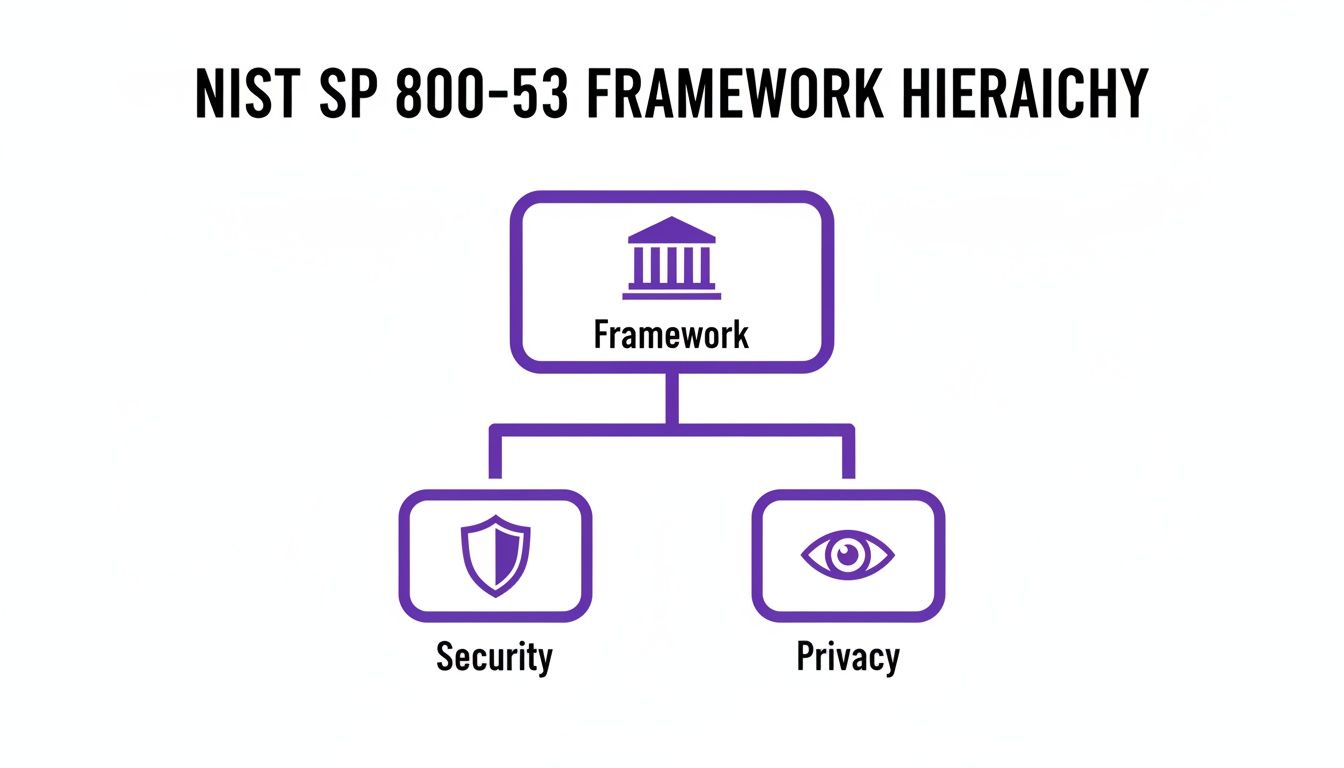
What this shows is an integrated strategy. Security and privacy aren't treated as separate goals but as two sides of the same coin, both essential for building a truly resilient defence.
A Practical Look at Key Control Families
Instead of getting lost in all 20 families, let’s focus on a few that are highly relevant for SaaS companies and constantly appear in security questionnaires. When you see how these controls translate into real-world actions, the framework becomes far less intimidating.
Two of the most foundational families are Access Control (AC) and System and Information Integrity (SI).
- Access Control (AC): This is all about who gets the keys to which doors. It’s about enforcing the principle of least privilege, ensuring employees can only access the systems and data they absolutely need for their jobs—and nothing more. This directly addresses a major pain point: preventing data breaches caused by excessive user permissions.
- System and Information Integrity (SI): This family is your internal security detail. It focuses on shielding your systems from unauthorized changes and detecting breaches early, ensuring your infrastructure and data remain trustworthy.
These aren't just abstract concepts. They map directly to activities your engineering and IT teams are likely already doing.
The genius of the control families is they create a common language. When a potential customer asks if you implement 'AC-2 Account Management,' you can confidently point to your user access reviews and quarterly audits as concrete proof.
From Control Family to Actionable Task
So, how does a high-level control become a specific task on your team’s to-do list? Let's break it down with practical examples for a typical startup or SMB.
Example 1: Access Control (AC)
- Control: AC-2 Account Management
- What it means: You need a formal, repeatable process for managing the entire lifecycle of a user account—from creation and modification to disabling and removal.
- Actionable Tasks:
- Create a documented onboarding process that assigns system access based on a new employee's defined role.
- Schedule and perform quarterly reviews of all active user accounts to validate that their permissions are still appropriate.
- Use an offboarding checklist to ensure system access is revoked immediately when an employee leaves the company.
Example 2: System and Information Integrity (SI)
- Control: SI-4 System Monitoring
- What it means: You have to actively watch your systems to detect attacks and other unusual behaviour.
- Actionable Tasks:
- Set up logging tools on your servers, applications, and network devices to capture all relevant security events.
- Configure automated alerts for suspicious activity, like numerous failed login attempts from a single IP address.
- Assign a specific person or team the responsibility of reviewing security logs on a daily or weekly basis.
By breaking down the controls this way, it's clear that NIST SP 800-53 isn’t asking you to reinvent security from scratch. It provides a structured way to formalize and verify the good practices you already have, making your next security questionnaire much easier to complete.
How to Select the Right Control Baselines
Trying to implement all 1,000+ controls in the NIST SP 800-53 catalogue is a recipe for failure, especially for an SMB. It's not just overwhelming; it’s a massive waste of resources that could be spent on product development or sales.
The framework was never meant to be a one-size-fits-all checklist. It recognizes that a small startup handling marketing data has different security needs than a bank managing financial records. That’s where control baselines come in.
Think of baselines as pre-packaged security plans. You wouldn't use the same blueprint to secure a corner shop as you would a military research lab. The shop might get a solid lock and a camera, while the lab needs biometric scanners and armed guards. Baselines apply this same logic to your digital assets, ensuring your security investment is proportional to your risk.

The goal is to pick a starting point that protects your systems and data without saddling your team with expensive, unnecessary controls. This pragmatic approach is crucial for startups where every dollar and hour counts.
The Three NIST Control Baselines Explained
NIST SP 800-53 provides three standard baselines, each tied to the potential impact of a security breach. This aligns your security effort with the level of harm a compromise could cause to your business, customers, and reputation.
Low-Impact Baseline: For systems where a breach would be an annoyance, not a disaster. Think of a public website or an internal wiki with non-sensitive information. The focus here is on fundamental "cyber hygiene."
Moderate-Impact Baseline: This is the go-to starting point for most B2B SaaS companies and SMBs. It applies when a breach could cause serious damage—significant financial loss, operational disruption, or harm to individuals. If you store customer data or run core business applications, this is likely your baseline.
High-Impact Baseline: Reserved for systems where failure is catastrophic. A breach could threaten human life, cause massive financial turmoil, or damage national security. Think critical infrastructure, hospital life-support systems, or federal intelligence platforms.
For almost any startup or SMB, the choice will be between Low and Moderate. The High baseline is for highly regulated industries.
Determining Your System's Impact Level
How do you choose the right baseline? Start by assessing the potential impact of a security incident using the three pillars of information security: Confidentiality, Integrity, and Availability (the CIA triad).
For each system you operate, ask these critical questions:
- Confidentiality: What’s the worst that could happen if our data is exposed? (e.g., loss of trade secrets, major customer privacy violations).
- Integrity: What’s the damage if someone modifies or deletes our data? (e.g., incorrect financial reports, destroyed user trust).
- Availability: What happens if our users can't access the system or data when they need it? (e.g., lost revenue, operational chaos, failing to meet customer SLAs).
Once you've analyzed these scenarios, assign an impact rating—Low, Moderate, or High—to each of the three objectives for that system.
The overall impact level for your system is determined by the highest rating you assigned. For example, if your system has Low confidentiality and integrity needs but Moderate availability is critical, you must start with the Moderate baseline.
This "high-water mark" approach ensures your security investment is proportional to your actual risk. It stops you from over-spending on low-risk assets and gives you a confident, defensible answer when enterprise clients challenge you in security questionnaires.
Mapping NIST 800-53 to Other Frameworks Like ISO 27001
For any growing B2B vendor, the compliance landscape feels like a maze. You might be working towards ISO 27001 when a key prospect sends a security questionnaire based on NIST SP 800-53. Then, another asks for your SOC 2 report.
This doesn't mean you need to run three separate compliance programs. The good news is that these frameworks are all built on the same core security principles. By understanding how they connect, you can adopt a powerful "implement once, prove many" strategy.
This approach, known as control mapping, is your ticket to working smarter, not harder. It allows you to use evidence from your ISO 27001 audit to satisfy a NIST-based request, or leverage your SOC 2 controls to show alignment with NIS 2.
Finding the Common Ground
Think of these frameworks as different languages describing the same ideas. ISO 27001 might require a "user access management policy," while NIST SP 800-53 talks about the "Access Control (AC)" family and controls like "AC-2 Account Management." Both are asking the same question: "Do you have a solid process for managing who can access your systems?"
This overlap is extensive. A huge portion of the measures required by frameworks like ISO 27001 and the SOC 2 Trust Services Criteria have direct counterparts in the NIST SP 800-53 control catalogue.
The magic of control mapping is efficiency. By connecting the dots between frameworks, you build a unified control environment. This lets you reuse evidence, simplify audits, and answer security questionnaires much faster, solving a major pain point for lean teams.
This strategy is especially valuable for European companies selling globally. Many French organizations, for instance, now use NIST SP 800-53 to bridge local regulations and international client expectations. A recent study found that over 40% of large French enterprises use a NIST publication to complement their ISO 27001 programme, mainly to satisfy questionnaires from multinational customers. According to these findings on NIST adoption in Europe on securecontrolsframework.com, this helps French SaaS vendors demonstrate control equivalency, which can shorten sales cycles with US-based clients by weeks.
Practical Mapping Examples
Let's see how this works in practice. Many controls from ISO 27001 Annex A map directly to NIST SP 800-53 families. To dive deeper into these, you can learn more about ISO 27001 Annex A controls here.
The table below shows a few examples of how NIST SP 800-53 controls align with ISO 27001 and SOC 2 requirements.
NIST 800-53 Control Mapping Examples
| NIST SP 800-53 Control Example | Related ISO 27001:2022 Control | Related SOC 2 TSC |
|---|---|---|
| AC-2 (Account Management) | A.5.15 Access Control, A.5.16 Identity Management, A.5.18 Access Rights | CC6.1, CC6.2, CC6.3 |
| IR-6 (Incident Reporting) | A.5.26 Mgmt. of InfoSec Incidents | CC7.3 Incident Management |
| SI-4 (System Monitoring) | A.8.16 Monitoring Activities | CC7.1, CC7.2 System Monitoring |
| PE-3 (Physical Access Control) | A.7.1 Physical Security Perimeters, A.7.2 Physical Entry | CC6.6 Physical Access Controls |
By documenting these relationships, you build a powerful translation layer for your compliance program.
When a client asks how you address NIST control SI-4, you can point to the robust logging and monitoring systems you already implemented for ISO 27001 control A.8.16 and your SOC 2 reporting.
This doesn't just save you from redundant work. It demonstrates a mature, well-organized security posture, showing prospective clients that your program is thoughtful and integrated. That trust helps accelerate procurement and close deals faster.
A Practical Implementation Plan for Startups
Knowing the theory behind NIST SP 800-53 is one thing, but putting it into practice without derailing your product roadmap is the real challenge. For startups and SMBs, the secret is a pragmatic, risk-based approach that values progress over perfection. This isn't about ticking off all 1,000+ controls overnight; it's about building a solid security foundation that scales with your company.
The real goal is to transform a daunting project into a manageable, repeatable business process. This section breaks down an actionable step-by-step plan for teams short on time and resources.

Step 1: Define Your Scope
Before you touch a single control, define what you're protecting. This scoping process is the most critical first step. An undefined scope leads to wasted effort protecting low-value assets while your crown jewels remain exposed—a common and costly mistake.
Start by mapping your entire technical environment. Pinpoint every system, application, database, and network component that processes, stores, or transmits sensitive data. For a SaaS company, this includes your production cloud environment, customer support platforms, and any third-party services that handle customer information.
For each component, note its purpose and the data it handles. This simple exercise provides immense clarity and ensures your team focuses its limited resources where they matter most.
Step 2: Select Your Baseline and Perform a Gap Analysis
With a clear scope, it’s time to choose your control baseline. As discussed, for most startups, this will be the Low or Moderate baseline. Choose the baseline that aligns with the highest impact rating (Confidentiality, Integrity, or Availability) of any system within your scope.
Next, conduct a gap analysis. This is a methodical comparison of the required NIST controls against the security measures you already have.
- List Your Required Controls: Use a spreadsheet or a compliance platform to list every control from your chosen baseline.
- Document Existing Practices: For each control, write down what your company is currently doing. You’ll be surprised how many security practices are already happening informally.
- Identify the Gaps: Mark each control as "Implemented," "Partially Implemented," or "Not Implemented." This process creates a clear, actionable picture of your security posture and highlights your weaknesses.
Step 3: Prioritise and Remediate Based on Risk
Your gap analysis will produce a to-do list that might seem overwhelming. The key is to prioritise based on risk. A missing firewall rule on a production database is far more critical than an outdated policy document.
Use a simple risk matrix to score each gap on its potential impact and the likelihood of exploitation. Focus your initial energy on the high-risk, high-likelihood items first.
A risk-based approach ensures you fix the most dangerous problems first. This demonstrates a mature security mindset to auditors and enterprise clients, showing that you effectively manage risk and aren't just "checking boxes."
This is where compliance automation platforms are invaluable for SMBs. Instead of getting lost in spreadsheets, these tools centralize your gap analysis, help assign remediation tasks, and track progress, turning a chaotic project into a continuous improvement cycle. Our guide on cybersecurity compliance for startups offers a great starting point.
Step 4: Collect Evidence and Monitor Continuously
Finally, compliance isn’t a one-time project; it’s an ongoing program. As you implement controls, you must collect evidence to prove they are working. This evidence is exactly what you'll use to answer security questionnaires and pass audits.
Evidence can include:
- Screenshots of system configurations.
- Policy documents and procedure manuals.
- Logs from security monitoring tools.
- Reports from vulnerability scans.
Keep all evidence organized in a central repository. A modern compliance tool automates much of this by linking evidence directly to controls. This not only saves hundreds of hours but also ensures you are always audit-ready, allowing you to respond to customer requests instantly.
Turn Security Questionnaires into a Sales Advantage
For any B2B sales team, a hefty security questionnaire is a deal-killer. It brings a promising conversation to a screeching halt and pulls engineers away from revenue-generating work. But what if you could flip the script and turn this painful compliance task into a tool that builds trust and accelerates sales?
The secret is to get ahead of the game. By proactively mapping your security controls to a respected framework like NIST SP 800-53, you shift from a reactive scramble to a strategic position. This lets you build a library of well-documented, evidence-backed answers that showcase a mature, organized security program.
Build a Reusable Answer Library
Stop treating every questionnaire like a new emergency. Most of them ask the same core questions. When you document your controls against NIST SP 800-53, you create a single source of truth for your entire security posture.
This is where modern compliance platforms prove their worth for SMBs. They help you pull together precise, evidence-backed responses in minutes, not days. Instead of constantly bothering engineers for technical details, your sales team can grab pre-approved, accurate answers from a central library. This ensures every response is consistent and professional. For more on this, check out our guide on how to answer security questionnaires quickly.
Proactively Showcase Your Security Posture
Why wait for the questionnaire at all? A public-facing Trust Center is the perfect way to share your compliance status proactively. This portal can be a one-stop shop for your certifications, audit reports, and security documentation, letting potential customers perform their own due diligence.
By making your security posture transparent, you reduce the number of questionnaires you receive. More importantly, you build trust before the first sales call ever happens. This transparency is a huge differentiator in a crowded market.
Turning compliance into a sales asset is a strategic move, not unlike applying Blue Ocean Strategy principles to your go-to-market plan. By aligning with a rigorous framework like NIST, you aren't just ticking a box; you're building a sales enablement engine. This proactive approach empowers your team to close deals faster and with more confidence, transforming a major pain point into a genuine competitive edge.
Frequently Asked Questions
When you're first getting to grips with NIST SP 800-53, a few questions always seem to pop up. Let's tackle the most common ones we hear from startups and growing SaaS businesses.
Is NIST SP 800-53 a Legal Requirement for My Business?
For most private companies, especially SMBs, the answer is no—it's not a legal mandate. NIST SP 800-53 is strictly required for U.S. federal agencies and their contractors.
However, its influence has spread far beyond government work. Large enterprises in sectors like finance and healthcare have adopted it as their internal security standard. They expect their vendors—even startups—to demonstrate alignment. So, while it may not be law for your SaaS company, it's quickly becoming a commercial necessity to win larger, more lucrative contracts.
What Is the Difference Between NIST SP 800-53 and the NIST CSF?
This is a common point of confusion. The easiest way to think about it is that the NIST Cybersecurity Framework (CSF) is the "what," and NIST SP 800-53 is the "how."
NIST CSF: This is your high-level strategy. It organizes cybersecurity into five simple functions: Identify, Protect, Detect, Respond, and Recover. It’s perfect for explaining your security program to your board or non-technical stakeholders.
NIST SP 800-53: This is the deep-dive tactical guide. It’s a comprehensive catalogue of the specific security and privacy controls your technical teams will implement to bring the CSF's strategy to life.
They're designed to be used together. You'd use the CSF to define your goals and then turn to SP 800-53 for the detailed instructions to get there.
How Long Does It Take to Implement NIST SP 800-53?
There’s no single answer, as the timeline depends on your company's size, complexity, and current security maturity. The baseline you choose (Low, Moderate, or High) is also a major factor.
As a rough guide, a startup with a straightforward tech stack aiming for a Moderate baseline could be looking at a project of 6 to 18 months. This covers initial scoping, a gap analysis, remediation work, and gathering evidence.
The secret is to stop thinking of this as a one-off project. View it as building the foundation for a continuous security program. Automation can make a world of difference, both in speeding up the initial effort and in making ongoing management easier and less resource-intensive.
It's all about making steady, risk-prioritized progress. By tackling your biggest risks first, you build a more resilient security posture over time that wins customer trust.
Stop drowning in security questionnaires and start closing deals faster. Compli.st uses AI to generate precise, evidence-backed answers in minutes, centralises your compliance documentation, and builds a public Trust Center to reduce inbound requests. See how you can turn your compliance efforts into a sales advantage at https://www.compli.st.