For small to medium-sized businesses and startups, the constant pressure to manage cybersecurity threats can be overwhelming. Risk management with ISO 27005 provides a structured, internationally recognized framework to find, analyze, and treat information security risks before they become business-disrupting incidents. It's crucial to understand that ISO 27005 isn't a certification you can achieve. Instead, it's the practical instruction manual—the how-to guide—for mastering the risk management requirements demanded by frameworks like ISO 27001.
Why Your Business Can't Afford to Ignore an ISO 27005 Strategy
If you're running a growing business, cybersecurity can often feel like a constant firefighting exercise, reacting to threats as they emerge. This reactive approach is not just costly and unpredictable; it’s a major red flag for auditors and enterprise clients who demand proof of a mature security posture. This is the exact pain point a formal risk management process, guided by ISO 27005, is designed to solve.
Let’s put it another way. Achieving compliance with frameworks like ISO 27001, SOC 2, NIS 2, or DORA is your destination; it proves your company has a solid Information Security Management System (ISMS). ISO 27005 is the strategic roadmap you follow to get there. It gives you a framework to make smart, evidence-based decisions instead of guessing where your next vulnerability might be.
Moving Beyond Compliance Checkboxes
Adopting the ISO 27005 framework helps you shift from a reactive security stance to a proactive one. You stop randomly buying security tools and start strategically protecting your most critical assets based on a clear-eyed view of your actual threats and business impact. This is what it means to build a resilient, defensible security program.
This structured thinking delivers immediate, high-value business advantages:
- Satisfy Auditors: It provides the documented, repeatable process auditors require, proving your risk management is logical and effective.
- Accelerate Sales: It arms your sales team with concrete answers for security questionnaires, demonstrating a mature security program that helps unblock and close enterprise deals faster.
- Protect Company Assets: It focuses your limited budget and resources on mitigating the risks that pose the greatest threat to your operations, data, and reputation.
An effective risk management program isn't an academic exercise; it's a core business function. It turns security from an operational cost center into a strategic enabler for growth, trust, and resilience.
Budgeting for Success in the French Market
Implementing and maintaining an ISMS requires a dedicated budget. For French companies aiming for ISO 27001, auditors often suggest having the system operate for 6–12 months to gather enough evidence that the risk treatments are effective.
Because of this, French organisations typically set aside an average of 0.5–2.5% of their annual IT/OT operating budgets for ISMS maintenance and ISO-aligned risk management work. You can learn more about the resource planning involved for ISO 27005 and ISO 27001 in France. This investment is absolutely crucial for building a security foundation you can rely on.
Executing the ISO 27005 Risk Management Lifecycle
Moving from theory to practice is where many businesses get stuck. The ISO 27005 risk management process isn’t a one-time project; it’s a continuous cycle designed to keep your security posture aligned with your business reality. Think of it as a recurring health check for your information security, ensuring you always know where your biggest vulnerabilities are and what you’re doing about them.
The entire process is broken down into clear, repeatable phases. For a startup or SMB, mastering this cycle is the most direct path to building a defensible security program that will satisfy auditors for frameworks like ISO 27001, SOC 2, or NIS 2.
Let’s walk through each stage with actionable examples.
Establishing the Context
Before you start hunting for risks, you must define your operational landscape. This foundational step, Context Establishment, is about understanding your business, its objectives, and its boundaries. It’s where you answer the big-picture questions that will shape the entire risk management process.
For instance, a FinTech startup’s context would involve mapping its core assets (customer financial data, transaction logs, proprietary algorithms), understanding its legal and regulatory obligations (like GDPR or DORA), and identifying key stakeholders (investors, regulators, enterprise clients).
This is also the stage where you define your risk criteria. This means setting your company’s risk appetite—the amount and type of risk you are willing to accept to achieve your business goals. A pre-launch startup might have a higher appetite for operational risk than an established company handling sensitive healthcare data.
Identifying Your Information Security Risks
Once your context is clear, you can begin Risk Identification. The objective is to create a comprehensive list of everything that could potentially harm your critical information assets. This isn't the time for deep analysis; it’s a structured brainstorming exercise to uncover what could go wrong.
To do this effectively, think in three parts:
- List Your Assets: What information and systems are vital to your business? This includes data (customer PII, source code), hardware (servers, laptops), and software (SaaS platforms, internal applications).
- Identify Threats: What could harm these assets? Think broadly—from ransomware attacks and insider threats to simple misconfigurations in your cloud services.
- Pinpoint Vulnerabilities: What weaknesses could a threat exploit? This could be unpatched software, a lack of employee security training, or insufficient access controls.
A risk exists where these three elements intersect. For example, a threat (a phishing attack) could exploit a vulnerability (untrained staff) to compromise an asset (your customer database). The goal of this phase is to document every plausible risk scenario in a risk register.
The diagram below, adapted from the ISO standard, illustrates how the process flows, with identification feeding into analysis and evaluation.
As the official flow illustrates, risk management isn’t a straight line. It’s a loop, with constant communication and monitoring to ensure the system stays relevant as your business changes.
Analysing and Evaluating Risks
With a list of identified risks, the next step is to determine which ones actually matter. This occurs through Risk Analysis and Risk Evaluation, where you shift from "what could happen?" to "how likely is it, and how bad would it be?"
Risk Analysis is where you estimate the likelihood and potential impact of each risk.
- Likelihood: How probable is it that this risk will materialize? You can use a simple scale like High, Medium, Low, or a numerical rating (e.g., 1-5).
- Impact: If the risk occurs, what is the business damage? This could be financial loss, reputational harm, or legal penalties, often rated on a similar scale.
Multiplying these two factors gives you a risk score. This data-driven approach quickly reveals that a high-likelihood, high-impact risk (like a ransomware attack on your production database) demands immediate attention.
Risk Evaluation then involves comparing these scores against the risk criteria you defined earlier. This is the crucial prioritization step where you decide which risks are unacceptable and must be treated, which are tolerable, and which fall somewhere in between.
By systematically analysing and evaluating risks, you transform a long list of potential problems into a clear, prioritised action plan. This data-driven approach ensures your limited resources are focused on the threats that truly matter to your business.
Treating and Accepting Risk
Once you have prioritized your risks, it’s time for action. This is the Risk Treatment phase, where you decide how to respond to each unacceptable risk. ISO 27005 outlines four main treatment options. The collection of your chosen responses forms your Risk Treatment Plan (RTP).
Finally, Risk Acceptance is a formal acknowledgement from management that any remaining risks (the "residual" risks after treatment) are within the company's stated risk appetite. This step is critical for accountability and demonstrates to auditors that your leadership has made conscious, informed decisions about the company's security posture.
The entire lifecycle is supported by continuous communication and review, ensuring your risk management program evolves with your business.
To bring it all together, here’s a quick summary of how these phases look in practice for a small-to-medium-sized business (SMB).
The ISO 27005 Risk Management Process
| Lifecycle Phase | Primary Objective | Example SMB Activity |
|---|---|---|
| Context Establishment | Define the scope, rules, and boundaries for risk management. | The leadership team defines the company's risk appetite and identifies key legal obligations like GDPR and DORA. |
| Risk Identification | Create a comprehensive list of potential information security risks. | Conduct a workshop with department heads to brainstorm threats to key assets like customer data and source code. |
| Risk Analysis | Estimate the likelihood and impact of each identified risk. | The security team assigns a 1-5 score for Likelihood and Impact to each risk in the register. |
| Risk Evaluation | Compare risk scores against criteria to prioritise them for action. | Sort the risk register by the calculated risk score to create a prioritised list; anything above a score of 15 is deemed "unacceptable." |
| Risk Treatment | Select and implement controls to reduce, avoid, transfer, or retain risks. | For a high-priority risk like "unpatched servers," create a project to implement an automated patch management tool. |
| Risk Acceptance | Formally acknowledge and approve any remaining (residual) risks. | The CTO signs off on the residual risk of a minor data-entry error, accepting it as within the company's appetite. |
| Communication & Monitoring | Share risk information and continuously review the risk landscape. | Hold quarterly risk review meetings and update the risk register based on new threats or business changes. |
This table shows that while the terms might sound academic, the activities are very practical. Mastering this repeatable process is the key to building a resilient and compliant security programme.
Creating Your Audit-Ready Risk Management Deliverables
Running the risk management lifecycle is the engine of your security program, but auditors and enterprise clients want to see the proof. They need tangible evidence—concrete documents that prove your process isn't just a theory on a whiteboard but a living, breathing part of your operations. These deliverables are the direct output of your risk management ISO 27005 process and form the backbone of your audit defense.
Without clear documentation, even the best risk management efforts are invisible. For startups, producing polished, audit-ready deliverables is what separates a mature security posture from one that raises red flags. Think of these documents not as a compliance chore, but as strategic tools for communicating risk and driving real security improvements.
This visual flow shows the core steps in the ISO 27005 process, which directly lead to the deliverables we're about to break down.
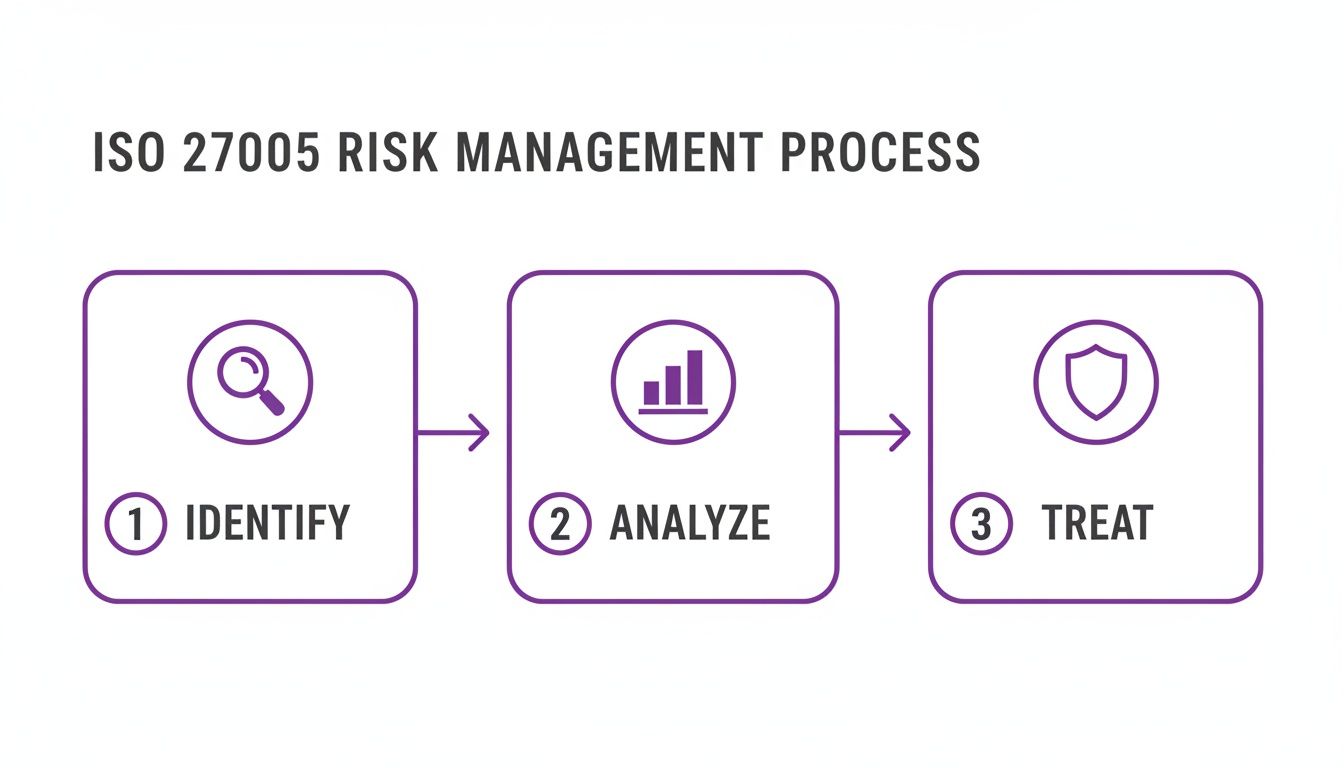
As you can see, a structured process of identifying, analysing, and then treating risks is the foundation for creating meaningful and defensible documentation.
The Cornerstone: Your Risk Register
The Risk Register is the single most important document in your risk management program. It's the central ledger for every potential security risk your company faces. This must be a living document, not a "set it and forget it" spreadsheet. It should capture the entire lifecycle of each risk, from identification to resolution.
An auditor will spend significant time reviewing this document. A well-organized register immediately demonstrates a systematic approach, giving them confidence in your entire process.
At a minimum, every entry in your risk register needs these critical fields:
- Unique Risk ID: A simple tracker (e.g., R-001) for organization.
- Risk Description: A clear, concise statement of the risk scenario.
- Asset(s) Affected: The specific data, system, or process at risk.
- Risk Owner: The individual accountable for managing the risk.
- Likelihood Score: Your estimate (e.g., 1-5) of the probability of occurrence.
- Impact Score: An estimate (e.g., 1-5) of the business damage if it occurs.
- Overall Risk Level: The calculated score (Likelihood x Impact), often color-coded (High, Medium, Low).
- Treatment Plan: A summary of the decided action.
This detailed record-keeping isn't just for auditors. A robust risk register is also a key requirement for data protection regulations. For anyone operating under GDPR, you can check out our guide on building a compliant GDPR register, which follows similar principles of structured data management.
Visualising Priorities With a Risk Heatmap
While your risk register is packed with detail, it can be overwhelming for leadership. That’s where a Risk Heatmap is invaluable. It translates complex spreadsheet data into a simple, visual story that anyone can understand in seconds. By plotting risks on a matrix based on likelihood and impact, it uses colors like red, amber, and green to instantly highlight your biggest problems.
This visual tool is incredibly powerful for communicating priorities to the C-suite or board. In a single glance, they can grasp the overall risk landscape and see exactly why you need to allocate resources to tackle those high-priority "red" items. It turns an abstract discussion about risk scores into a clear business conversation about what to fix first.
A Risk Heatmap bridges the gap between technical risk analysis and executive decision-making. It ensures that everyone, from the security team to the CEO, is aligned on which threats require immediate attention.
Driving Action With a Risk Treatment Plan
Finally, the Risk Treatment Plan (RTP) is your strategic action plan. It moves beyond identifying risks to detailing exactly how you're going to address them. For every unacceptable risk, the RTP outlines the specific steps, timelines, and responsibilities for remediation.
This is where risk management becomes tangible. The RTP links each risk directly to a specific action, whether that’s implementing a new security control from ISO 27001 Annex A, purchasing cyber insurance, or formally accepting a low-level risk.
A solid RTP must include:
- The identified risk (linking back to the Risk Register ID).
- The chosen treatment option (e.g., Modify, Share, Avoid).
- The specific control or action to be implemented.
- The person responsible for execution.
- A clear deadline for completion.
- The expected residual risk level after treatment.
Together, these three deliverables—the Register, the Heatmap, and the RTP—give you a complete and defensible package. They prove your risk management process is not only well-defined but is also actively moving your organisation toward a stronger, more resilient security posture.
Connecting ISO 27005 to ISO 27001 and Security Questionnaires
For any growing business, efficiency is survival. You can't afford to duplicate effort. That's why it’s critical to understand how your risk management ISO 27005 process acts as a force multiplier for your entire compliance program. This isn't about creating more work; it’s about making your efforts count multiple times over, especially for ISO 27001 certification and—just as importantly—enabling your sales team to close deals.
Think of it this way: ISO 27001 tells you what security outcomes you need, while ISO 27005 provides the recipe for how to achieve the risk management part. When an auditor assesses your Information Security Management System (ISMS), they will scrutinize the clauses mandating a formal risk management process. The work you do following ISO 27005 directly provides the evidence they need to see.
Mapping Risk Management Directly to ISO 27001 Clauses
Your ISO 27005 activities are not separate from your ISO 27001 preparations; they are the engine driving it. Several mandatory clauses in ISO 27001 are explicitly fulfilled by the deliverables your ISO 27005 lifecycle produces.
- Clause 6.1.2 Information security risk assessment: This clause demands that you establish and maintain a formal risk assessment process. Your entire ISO 27005 methodology—from context establishment to risk evaluation—is the direct evidence required to satisfy this.
- Clause 6.1.3 Information security risk treatment: This requires you to select appropriate risk treatment options and create a Statement of Applicability (SoA). Your Risk Treatment Plan (RTP) is the primary document that meets this need, clearly linking identified risks to specific Annex A controls.
- Clause 8.1 Operational planning and control: This clause requires you to plan and implement the processes needed to meet security requirements, which is exactly what your risk treatment plan orchestrates.
By following the ISO 27005 framework, you are systematically building the exact evidence an auditor is looking for, saving you time and stress.
Transforming Compliance into a Sales Enablement Tool
But satisfying auditors is only half the story. Your risk management deliverables become powerful assets in your sales cycle. Every B2B startup knows the pain of vendor security questionnaires—massive spreadsheets with hundreds of questions that can stall a deal for weeks. Your Risk Register and Risk Treatment Plan become a pre-packaged library of evidence-backed answers.
When a potential enterprise client asks how you protect their data, you don't have to scramble. You can point directly to a specific risk in your register, show them how you’ve analysed it, and demonstrate the exact controls you have in place to treat it.
This approach shifts your risk management from a compliance chore into a powerful sales tool. It proves you have a mature, proactive security posture, building the trust needed to close deals faster.
This is especially true in markets with strong local regulatory frameworks. In France, for instance, ISO 27005 is often used alongside national methods. Studies conducted between 2018 and 2024 showed that while roughly 40–60% of French organisations implementing ISO 27001 referenced ISO 27005, many also used ANSSI’s EBIOS RM method to align with local expectations. This blended strategy shows how an internationally recognised framework like ISO 27005 provides the robust risk management evidence needed for cross-border business. You can discover more insights about how French organisations blend ISO 27005 and EBIOS RM.
For lean teams, automating evidence collection is key. Modern compliance platforms centralize these risk management outputs, making them instantly accessible for security questionnaires. If you're exploring ways to streamline this, our guide on the 5 best Vanta alternatives can help you find tools to manage compliance evidence efficiently. This strategic link between risk, compliance, and sales is how smaller teams compete and win.
Moving from Manual Spreadsheets to Automated Compliance
For most startups and SMBs, the initial journey into formal risk management with ISO 27005 begins in a spreadsheet. It’s familiar, accessible, and seems like a reasonable starting point.
But this initial comfort quickly turns into a significant bottleneck. The manual approach becomes plagued by version control nightmares, inconsistent data, and a growing sense of dread as the audit date approaches.
The real problem isn't just the administrative burden; it's the lack of agility. A spreadsheet is a static snapshot of your risks at one moment in time. Your actual risk landscape is dynamic. A new product feature, a critical vendor, or an emerging cyber threat can render your risk register obsolete overnight. This is where dedicated compliance automation platforms are a game-changer, transforming risk management from a painful, periodic task into a continuous, reliable business function.
The Problem with Manual Risk Management
Managing information security risk in a spreadsheet is like navigating a busy motorway with a paper map—you're working with outdated information from the start. For lean teams already wearing multiple hats, this means spending hundreds of hours on low-value data entry instead of on what actually matters: reducing risk.
Here are the classic pain points that kill productivity and increase risk:
- Version Control Chaos: Multiple copies of the risk register float around in emails and shared drives. No one is sure which is the "source of truth."
- Error-Prone Data Entry: Manually calculating risk scores is a recipe for human error. One wrong formula can lead to mis-prioritized risks, meaning you’re solving the wrong problems.
- Disconnected Workflows: The risk register exists in a vacuum, completely detached from the controls meant to treat the risks. Tracking progress is a frustrating, manual chase for updates.
- Lack of Real-Time Visibility: By the time a spreadsheet is updated and shared, the information is already stale. You’re making critical decisions based on old news.
This manual drag doesn’t just slow down your security program; it fails to inspire confidence in auditors or enterprise customers who expect a mature, dynamic approach to risk.
The Power of an Automated System
An automated compliance platform is engineered to solve these problems. It acts as the central nervous system for your risk management lifecycle, connecting assets, risks, controls, and evidence in one place. It creates an efficient, reliable, and auditable system that empowers a small team to run a world-class security program.
Instead of fighting with spreadsheet formulas, your team can focus on strategy. The platform handles the heavy lifting, such as continuously monitoring controls and automatically flagging changes that might impact your risk level. It can automate evidence collection, linking a risk treatment plan directly to the live technical proof that a control is working.
Automation transforms your risk management process from a static, reactive chore into a dynamic, proactive system. It frees up your team's most valuable resource—time—to focus on making strategic security decisions, not just managing documents.
Automation is also indispensable for mapping risks to controls across multiple frameworks. A single risk, like "unauthorised access to customer data," might relate to controls in ISO 27001, NIS 2, DORA, and SOC 2. Our guide on preparing for a SOC 2 Type 2 audit explains how critical continuous monitoring is—something nearly impossible to prove without an automated system. A platform handles this complex mapping for you, ensuring that a single action satisfies multiple compliance obligations.
Before and After: A Clear Comparison
To see the difference, let’s compare the two approaches side-by-side. The table below shows how specific activities are transformed when you move from a manual to an automated system. This is about more than just efficiency; it’s about building a security program that enables growth.
| Activity | Manual Approach (Spreadsheets) | Automated Approach (Compliance Tool) |
|---|---|---|
| Risk Updates | Manually updated quarterly; often out of date. | Continuously updated based on real-time control monitoring. |
| Evidence Gathering | A frantic, manual scramble before an audit. | Automated and linked directly to risks and controls. |
| Control Mapping | A complex, manual cross-referencing task. | Automatically maps risks to controls across multiple frameworks. |
| Reporting | Time-consuming creation of static charts and reports. | Instant generation of dynamic dashboards and heatmaps. |
| Audit Preparation | Days or weeks spent organising scattered files. | Audit-ready evidence available with a single click. |
Ultimately, making the switch to an automated platform can save you hundreds of hours, reduce your compliance costs, and build a security posture that doesn’t just pass audits but actively helps you win and keep valuable enterprise customers.
Making Your Risk Treatment Plan Actionable and Effective
A Risk Treatment Plan (RTP) isn't just another document for auditors; it's your strategic playbook for security improvement. This is where the risk management ISO 27005 process converts analysis into real-world action. A plan left on a shared drive is a massive missed opportunity to genuinely reduce your company's risk exposure. The true value is in bringing it to life.
After evaluating your risks, you have four strategic options for how to handle them:
- Modify: This is your most common option. You implement security controls to reduce the likelihood or impact of a risk. Deploying multi-factor authentication (MFA) to protect critical accounts is a classic example.
- Retain: Sometimes, the cost to fix a risk outweighs the potential damage. In this case, you formally accept it, documenting the decision so everyone knows it was a conscious choice, not an oversight.
- Avoid: This means stopping the activity that creates the risk. If a new third-party integration is riddled with security flaws, you might avoid the risk entirely by cancelling the project.
- Share: This involves transferring a portion of the risk to another party. The most common example is purchasing cyber insurance, which offloads the financial impact of a data breach to your insurer.
Prioritising for Maximum Impact
For an SMB or startup, resources are always limited. You can't fix everything at once, which is why prioritization is critical. Your risk evaluation, with its likelihood and impact scores, provides the data needed to decide what to tackle first. Your RTP should focus your team's limited time and budget on the highest-scoring risks—the ones that pose a genuine threat to the business.
This focused approach ensures every action delivers the biggest possible reduction in your overall risk profile. Crucially, every treatment in your plan must link to a specific control, often from ISO 27001 Annex A. This creates a clear, auditable trail from risk identification to resolution.
An effective Risk Treatment Plan translates analysis into action. It’s the bridge between knowing what your risks are and measurably improving your security posture, ensuring limited resources are applied where they matter most.
Data from the French market illustrates this. Between 2019 and 2023, organisations using ISO 27005 guidance tended to allocate 55–70% of their risk treatments to technical controls and 25–35% to organisational ones. Only about 5–15% were assigned to risk transfer options like insurance. This strategic allocation, driven by solid analysis, resulted in a reported 40–65% reduction in high-rated residual risks within just 6 to 12 months. You can learn more about these risk treatment findings.
ISO 27005: Your Questions Answered
When you're first getting to grips with a new framework, it’s only natural to have a few questions. For growing businesses stepping into formal risk management with ISO 27005, a couple of common uncertainties often pop up. Let's clear those up right now.
Is ISO 27005 a Certification Like ISO 27001?
That's a great question, and the answer is no. ISO 27005 is purely a guidance standard; you can't actually get "ISO 27005 certified."
Think of it as the official playbook for risk management. It gives you the detailed, step-by-step methodology needed to satisfy the risk management requirements that are mandatory for achieving ISO 27001 certification. Following ISO 27005 is simply the best way to show an auditor that your risk process is solid and built to standard.
Do We Need to Hire a Full-Time Risk Manager for This?
For a startup or SMB, bringing on a dedicated risk manager is often out of the question. More often than not, this responsibility lands on the desk of the IT Manager, CISO, or Head of Compliance.
The most important thing is to assign clear ownership. Modern compliance automation platforms can be a game-changer here, drastically cutting down the manual effort. They empower one person to run the entire process without needing to be a full-time risk specialist, freeing them up to focus on more strategic security work.
How Often Should We Be Reviewing Our Risk Assessment?
ISO 27001 is specific on this: risk assessments must be reviewed at planned intervals or whenever significant changes happen.
As a rule of thumb, you should plan for a full, comprehensive review at least annually. But your risk register shouldn't just gather dust on a shelf; it needs to be a living document. We recommend a lighter-touch review more often—perhaps quarterly, or in response to triggers like a new security threat, a major change to your infrastructure, or a new product launch.
This "always-on" approach to monitoring ensures your security posture keeps pace with the reality of your business.
Ready to ditch the spreadsheets and build a risk management programme that an auditor will love? Compli.st offers an AI-powered platform to automate your entire ISO 27005 process, map risks directly to controls, and speed up your journey to ISO 27001 certification. Find out how you can save hundreds of hours and build a security programme that helps you win more business by visiting https://www.compli.st.