Privacy by Design is about embedding data protection into the DNA of your technology and business practices right from the get-go. It's a proactive mindset—building privacy controls directly into your systems rather than trying to patch them on as an afterthought. For a startup or SMB, this isn't just a compliance task; it's a critical business strategy.
From Afterthought to Advantage
Think of it like building a house. It’s far more sensible and secure to design fire safety features—like using fire-resistant materials and planning a clear escape route—into the original architectural blueprints. Trying to retrofit a sprinkler system and fire escapes after the house is already built is not just more expensive; it’s a lot less effective. Privacy by Design is the blueprint for data safety.

For startups and SMBs, this approach is a game-changer. It transforms compliance from a costly, frustrating chore into a powerful competitive advantage. Instead of being bogged down by expensive technical debt or project delays to fix privacy flaws later on, you establish a solid, trustworthy foundation from day one, helping you close enterprise deals faster.
The Real Cost of Neglecting Privacy
Ignoring this methodology creates painful business friction. A 2022 audit revealed that a staggering 81% of French companies remain non-compliant with GDPR, a clear sign of a widespread failure to embed privacy principles from the start. With potential fines climbing as high as 4% of annual global turnover, the financial risks are impossible to ignore. This compliance gap also directly stalls B2B sales, where slow, painful security questionnaires delay deals and frustrate potential customers.
Adopting Privacy by Design, on the other hand, delivers clear wins:
- Builds Customer Trust: Demonstrating respect for user data from the first interaction builds lasting loyalty and makes you a more attractive vendor.
- Accelerates Sales Cycles: A strong privacy posture makes security questionnaires far easier to complete, removing a major roadblock in procurement.
- Future-Proofs Your Business: It lays the essential groundwork for achieving critical certifications like ISO 27001, SOC 2, DORA, and NIS 2, which are vital for market credibility and enterprise readiness.
Privacy by Design isn't just a technical burden; it's a strategic business decision. It prepares your organisation for scalable growth and proves to the market that you take security and data protection seriously.
Understanding the components of an effective privacy policy is key to appreciating how this approach shapes your day-to-day data handling practices. This proactive stance ensures your policies aren't just documents but are actually reflected in how your systems work. By weaving privacy into your company’s culture, you can move faster, build stronger client relationships, and earn a reputation for excellence and reliability.
The 7 Foundational Principles of Privacy by Design
To truly weave Privacy by Design into your organisation's culture, you need to get past the buzzwords and understand what it actually means in practice. Dr. Ann Cavoukian laid out seven foundational principles that serve as a practical roadmap for building products and services people can trust. Think of them less as vague suggestions and more as a clear guide for making data protection a natural part of how you do business.
1. Proactive not Reactive; Preventative not Remedial
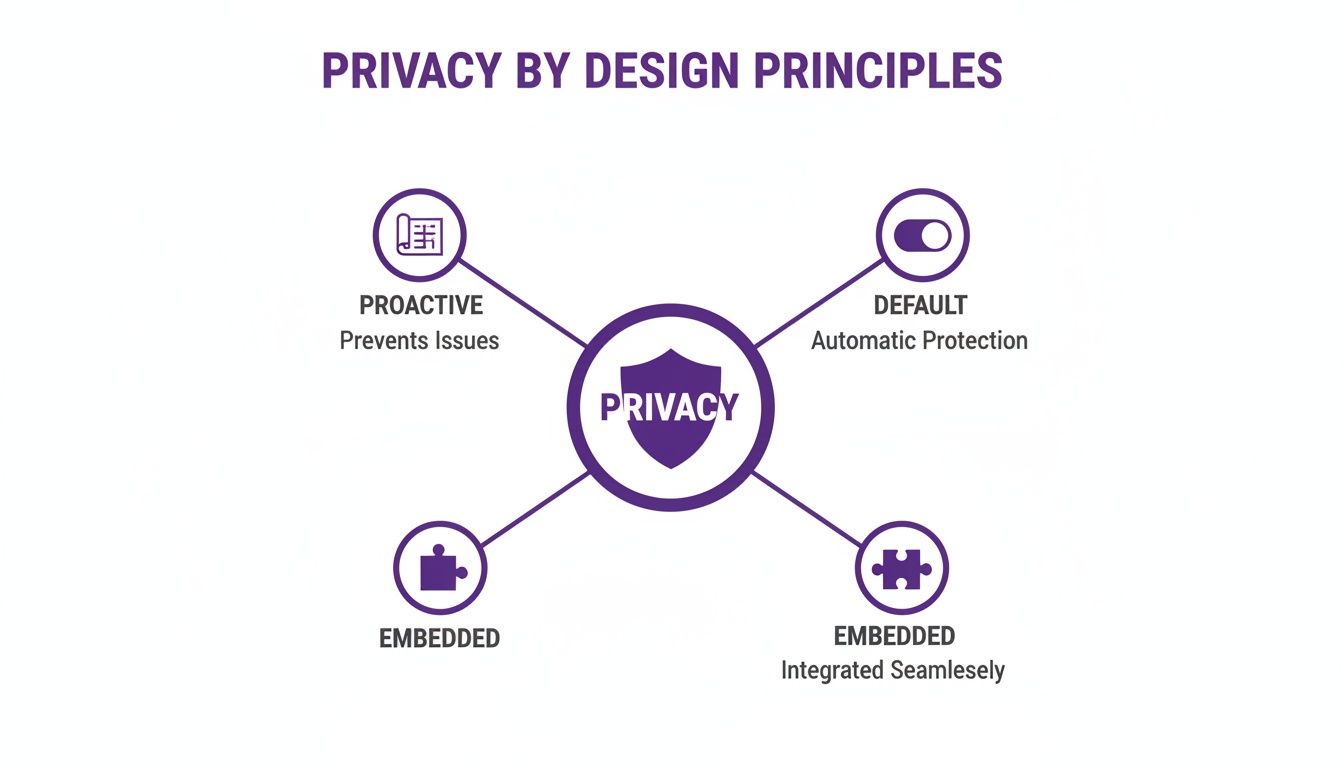
This first principle gets right to the heart of the matter. It’s about anticipating and heading off privacy risks before they ever become a problem. It’s the difference between building fire alarms into the walls from day one versus scrambling to install them after a fire has already started.
For a SaaS company, this means security and privacy checks are just part of the software development lifecycle (SDLC), right from the earliest planning stages. Instead of reacting to a vulnerability found after launch, your team spots and fixes the threat during the design phase. This saves a massive amount of time, money, and most importantly, your reputation.
2. Privacy as the Default Setting
This principle is simple but powerful: personal data should be protected automatically. Users shouldn't have to navigate a maze of settings to secure their privacy; it should be the default state from the moment they sign up. If you offer a choice, the most privacy-friendly option must be the one that’s pre-selected.
A classic example is the user onboarding flow for a new app. Instead of a pre-ticked box for marketing emails (an opt-out approach), privacy as the default demands that box be unticked (an opt-in approach). The user has to make a conscious, clear choice to share their data for anything non-essential. It’s a small shift that immediately builds trust and shows you respect their autonomy.
3. Privacy Embedded into Design
Privacy can't be a feature you bolt on at the end. It must be a core part of your system's architecture and functionality from the ground up. You wouldn't sell a car and offer brakes as an optional extra; in the same way, privacy has to be an integral, seamless part of the user experience.
This means your engineers and product managers need to be thinking about privacy at every turn. It’s not just the CISO's job. It’s a shared responsibility to make data protection a fundamental piece of the product’s DNA.
4. Full Functionality—Positive-Sum, not Zero-Sum
There’s a common myth that you have to choose between strong privacy and great functionality. This principle shuts that idea down completely. It insists that you can—and must—achieve both without making a trade-off. The goal is a "positive-sum" outcome where you deliver innovative features while upholding rock-solid privacy protections.
For instance, a data analytics feature can be designed using anonymised or aggregated data. This approach delivers valuable insights for your business without ever exposing an individual's personal information.
5. End-to-End Security—Full Lifecycle Protection
Data needs protection for its entire journey, from the instant it’s collected to the moment it’s securely deleted. This principle demands a holistic security strategy that covers data at rest (when it’s in storage), in transit (as it moves across networks), and in use.
This means implementing strong encryption, secure access controls, and robust deletion policies to protect information at every single stage.
6. Visibility and Transparency—Keep it Open
You have to be open and clear about how you handle personal data. Your privacy policies, your procedures, and the technologies you use should be easy for users, auditors, and regulators to understand.
This means writing privacy notices in plain language, not dense legalese, and being honest about what data you collect and why you need it. A public-facing Trust Centre is a fantastic way to put this commitment on full display.
7. Respect for User Privacy—Keep the User Central
Finally, everything you do must be user-centric. This means designing your systems and processes with the user’s best interests front and centre. This includes providing them with clear privacy controls, honouring their data subject rights quickly and efficiently, and always aiming to empower them.
When people feel they are in control of their own data, they are far more likely to trust you and engage with your services.
To bring it all together, here’s a quick-reference table that connects these principles to the day-to-day actions of a modern tech company.
The 7 Principles of Privacy by Design in Action
| Principle | Core Concept | SaaS Company Example |
|---|---|---|
| Proactive not Reactive | Anticipate and prevent privacy issues before they happen. | Integrating a Data Protection Impact Assessment (DPIA) into the feature development lifecycle. |
| Privacy as the Default | No action is needed from the user for their privacy to be protected. | User consent for marketing communications is unchecked (opt-in) by default during account creation. |
| Privacy Embedded into Design | Privacy is a core component of the system, not an add-on. | Building data minimisation rules directly into the application's database schema. |
| Full Functionality | Achieve both privacy and business objectives without a trade-off. | Providing personalised user recommendations based on aggregated, anonymised data sets. |
| End-to-End Security | Protect data throughout its entire lifecycle. | Encrypting all customer data both in transit (using TLS) and at rest (in the database). |
| Visibility and Transparency | Be open and honest about your data practices. | Publishing a clear, easy-to-read privacy policy and maintaining a public Trust Centre. |
| Respect for User Privacy | Keep the user's interests and rights at the forefront. | Creating a user-friendly dashboard where customers can easily view, edit, or delete their data. |
By translating these principles into concrete actions, you move from simply complying with regulations to building a genuine culture of privacy that becomes a key competitive advantage.
How Privacy by Design Makes Compliance Easier
Thinking about Privacy by Design isn't just about building customer trust—it's a strategic move that fundamentally simplifies how you tackle complex compliance frameworks. For growing businesses, the thought of juggling GDPR, ISO 27001, SOC 2, DORA, and NIS 2 can be overwhelming. This is where a proactive approach changes the game.
Instead of scrambling to meet the demands of each regulation one by one, you build a solid, privacy-first foundation. This core set of processes naturally addresses the overlapping requirements found across all these standards. You stop playing catch-up and avoid the last-minute panic when an audit is on the horizon or a security questionnaire lands on your desk.
The GDPR Connection: Data Protection by Design
Privacy by Design is more than just a good idea; it’s a legal requirement baked into Article 25 of the GDPR, where it’s called "Data Protection by Design and by Default." This rule means you’re legally obligated to build in the right technical and organisational safeguards from the very beginning of any project to protect people's data rights.
This mandate is the legal expression of the principles we've discussed. Concepts like data minimisation (only collecting what you absolutely need) and purpose limitation (only using data for the reason you collected it) aren't abstract theories. They are hands-on requirements that make your compliance work much simpler.
For a closer look at one of the most significant data protection frameworks, you can review the GDPR regulations. Embracing this proactive mindset is no longer optional; it's essential for meeting the demands of today's data protection laws.
From Principles to Practical Compliance
So, how do these high-level principles actually help when an auditor comes knocking? The link becomes crystal clear when you map them to real-world compliance tasks. A well-thought-out Privacy by Design strategy makes gathering evidence and creating documentation for multiple frameworks a much smoother process.
- Data Minimisation & Purpose Limitation: These principles are the bedrock of your Article 30 Records of Processing Activities (ROPAs) under GDPR. When you've already built in limits on data collection and use, documenting those activities is no longer a massive undertaking.
- End-to-End Security: This principle dovetails perfectly with the security controls demanded by ISO 27001, the criteria for SOC 2, and the resilience requirements of DORA and NIS 2. By embedding security throughout the entire data lifecycle, you’re already generating the proof you need for these audits without even trying.
This is all about shifting your perspective. By making privacy proactive, the default, and embedded in everything you build, compliance stops being a reactive headache and becomes a natural part of how you operate.
Meeting Market Demands and Sailing Through Audits
The push for better privacy isn't just coming from regulators. Your customers are demanding it, too. An IPSOS study revealed that 75% of French people see personal data protection as a major concern, which means businesses have to prove they’re serious about it.
This market pressure makes strong compliance a commercial necessity. It’s what helps you close deals, especially when you’re being scrutinised in vendor security reviews.
When you implement Privacy by Design, you're essentially creating a single, consistent story about how you handle data. This makes it far easier to answer security questionnaires and give auditors the evidence they need for SOC 2, ISO 27001, or any other framework.
Ultimately, this strategy cuts down on wasted effort and repetition. You're no longer chasing compliance; you’re building it into the DNA of your company. This makes your organisation more resilient, more trustworthy, and ready for whatever regulations come next.
A Practical Roadmap for Implementing Privacy by Design
Knowing the theory is one thing, but putting it into practice is where most organisations stumble. Rolling out privacy by design needs a clear, manageable plan, especially for startups and smaller businesses where time and resources are always tight. This roadmap breaks it all down into actionable steps, turning abstract principles into concrete business practices.
The goal here isn’t perfection overnight. It’s about building a sustainable culture of privacy. This means weaving privacy thinking into the daily workflows your teams already use, from product development right through to choosing a new supplier.
Start with Data Discovery and Mapping
You simply can’t protect what you don’t know you have. The first, most critical step is to get a complete inventory of all the personal data your organisation collects, processes, and stores. This is often called data mapping or creating a Record of Processing Activities (ROPA).
Essentially, this inventory needs to answer a few key questions for every type of data you handle:
- What data are you collecting? (e.g., names, email addresses, IP addresses)
- Why are you collecting it? (e.g., for user authentication, marketing analytics)
- Where is it stored? (e.g., which databases, cloud services)
- Who can access it? (e.g., the sales team, customer support, third-party vendors)
- How long do you keep it? (i.e., your data retention policy)
This activity is the bedrock of GDPR compliance, particularly for maintaining your Article 30 records. For a deeper look into this essential task, check out our guide on creating a GDPR register of processing activities. Automation tools can seriously speed this up by discovering data assets and generating these critical records for you.
Conduct Data Protection Impact Assessments
A Data Protection Impact Assessment (DPIA) is a formal way to spot and minimise the privacy risks of a new project, feature, or system before it goes live. Think of it as a proactive risk assessment, but purely focused on privacy. It’s a core part of privacy by design because it forces you to think through potential issues before a single line of code is even written.
A DPIA is especially important when you’re doing something that could be high-risk for individuals, like using new technologies or processing sensitive data at a large scale.
By building DPIAs into your development lifecycle, you shift from a reactive, "fix-it-later" mindset to a preventative one. This not only strengthens privacy but also saves you from costly redesigns and project delays down the road.
Integrate Privacy into Procurement
Your company's privacy posture is only as strong as its weakest link, and often, that link is a third-party vendor. Managing supply chain security and third-party risk is a huge headache for many businesses, which is why building privacy into your procurement process is non-negotiable.
Before you bring any new vendor on board, run them through a proper evaluation checklist to vet their security and privacy practices. This helps ensure your partners will handle data with the same level of care that you do.
Vendor Evaluation Checklist Essentials
| Category | Key Questions to Ask |
|---|---|
| Data Governance | Do you have a formal data protection policy? Can we review it? |
| Security Controls | How do you encrypt data, both at rest and in transit? |
| Compliance | What certifications do you hold (e.g., ISO 27001, SOC 2)? |
| Data Processing | Can you provide a list of all subprocessors that will handle our data? |
| Incident Response | What is your process for notifying us in the event of a data breach? |
Taking a structured approach like this makes vendor selection more objective and defensible. It helps you build a resilient and secure supply chain from the very start.
Implement Privacy Enhancing Technologies
Finally, you need to back up your policies with the right technology. Privacy-Enhancing Technologies (PETs) are tools specifically designed to minimise personal data use and maximise data security. For smaller businesses with tight budgets, implementing massive, costly solutions isn't always an option, but several effective PETs are very accessible.
Consider starting with these foundational technologies:
- Pseudonymisation: This is a technique that replaces personal identifiers with artificial ones, or pseudonyms. It immediately reduces risk because the data can no longer be tied back to a specific person without extra information, which you should always keep separate and secure.
- Encryption: This is a fundamental control. It makes data unreadable to anyone who shouldn't see it. Implementing strong encryption for data in transit (using TLS) and at rest (in your databases and storage) is a baseline requirement today.
- Access Controls: Enforce the principle of least privilege. This just means that employees and systems should only be able to access the absolute minimum data necessary to do their jobs. Role-based access control (RBAC) is a standard and effective way to manage this.
By following this practical roadmap, any organisation can start its privacy by design journey. It's a progressive path that builds momentum, reduces risk, and ultimately turns compliance from a burden into a powerful business advantage.
Turn Compliance into a Competitive Advantage
Let's be honest, most people see compliance as a necessary evil—a cost centre that drains resources. But thinking about privacy by design this way is a massive missed opportunity. When you're stuck in manual compliance cycles, you're not just slowing down; you're pulling your most creative people away from building great products. By embedding privacy into your operations with smart automation, you can flip the script and turn that cost centre into a real market advantage.
Nowhere is this shift more obvious than in the sales process. For most B2B tech companies, the security questionnaire is a sales cycle killer. These incredibly detailed documents land on your desk and bring everything to a grinding halt, demanding days of input from security and engineering teams who are already stretched thin.
Automate Questionnaires to Accelerate Sales
What if you could answer those complex security questionnaires in minutes, not days? This is where compliance automation completely changes the game. The idea is to build a single source of truth—an intelligent knowledge base created from your existing security documents, policies, and audit reports. With that in place, your sales team can generate accurate, source-cited answers on their own, instantly.
This isn't just a convenience; it's a critical fix for a major pain point, especially for start-ups and small businesses. Instead of pulling a senior engineer off a crucial project to answer the same questions for the tenth time, your sales team can keep deals moving. The system ensures every answer is consistent and backed by solid evidence, which goes a long way in building trust with potential clients from the very first interaction. It’s how you make frameworks like a SOC 2 certification work for you, not against you.
Effortless GDPR Compliance and Data Mapping
Another heavy lift in the world of manual compliance is keeping up with regulations like GDPR. Article 30, for instance, requires you to maintain a detailed Record of Processing Activities (ROPA). It’s a foundational piece of privacy by design, but because it’s so time-consuming to create and maintain, it often gets pushed to the back burner.
Modern compliance tools can automate this entire process. They scan your systems, discover where data lives, and generate the data maps and ROPAs you need automatically.
This automation doesn't just tick a GDPR box; it gives you a clear, real-time map of your entire data landscape. That kind of visibility is gold when you need to conduct accurate risk assessments or make smart decisions about data governance.
The benefits here are straightforward:
- Time Savings: Slash the hours spent manually documenting data processing activities.
- Accuracy: Remove the risk of human error and ensure your records are always current.
- Audit-Readiness: Walk into any regulatory audit with organised, comprehensive documentation ready to go.
Build Trust and Reduce Questionnaire Volume
A strong, proactive privacy posture does more than just keep auditors happy—it builds genuine trust with your customers. One of the most effective ways to do this is with a public-facing Trust Centre. It’s a central hub where prospects and customers can find all your security and compliance information, making it incredibly easy for them to see your commitment to protecting their data.
By giving them self-service access to documents like certifications, audit reports, and key security policies, you answer their questions before they even have to ask. This level of transparency can reduce the volume of security questionnaires you receive by up to 70%. Less time on questionnaires means more time building your product and closing deals.
This proactive stance is perfectly in sync with where regulations are headed. Take the recent CNIL guidelines on AI development, which double down on the need for privacy by design by mandating DPIAs and data protection right from the architectural phase. Tools that can ingest audit reports to provide precise, cited answers for questionnaires—while keeping all customer data completely separate—are becoming essential for navigating this new terrain.
At the end of the day, automating routine compliance tasks and showcasing your security posture isn't just about defence. It's an offensive strategy that shortens sales cycles, strengthens your brand, and delivers a tangible return on your investment in privacy.
Common Questions About Privacy by Design
Even when the benefits are clear, actually putting privacy by design into practice can feel like a huge undertaking, especially for startups and smaller businesses. A few legitimate concerns always seem to pop up. Let's tackle those head-on with some straight, actionable answers to get you moving forward with confidence.
Can a Lean Startup Afford This?
This is probably the number one question we hear, and it comes from a common misconception. The real question isn't whether you can afford to implement privacy by design, but whether you can afford not to. It’s not about buying expensive tools on day one; it's about making smarter, more cost-effective decisions from the very beginning.
Think about it: fixing a privacy flaw after your product is already in the wild is massively more expensive than preventing it in the first place. This is what we call "privacy debt," and it works just like technical debt—it piles up over time until it demands a disruptive, expensive fix. A data breach or a failed security audit can easily run into tens of thousands of euros in fines, lost deals, and a damaged reputation.
A study by IBM found the average cost of a data breach in 2023 was $4.45 million. For a smaller company, an incident on that scale isn't just a setback; it's an extinction-level event.
So, what do these early, cost-effective decisions look like?
- Choosing vendors with strong security postures: Vetting your suppliers costs nothing but a bit of time, but it saves you from inheriting someone else’s risk.
- Adopting data minimisation: Simply collecting less data means there's less to protect, secure, and manage. That’s a strategic decision, not a technical one.
- Building a secure development lifecycle (SDLC): Weaving security checks into your existing development workflow is a low-cost, high-impact process change.
These initial steps are about shifting your mindset and process, not blowing your budget. They create a foundation that prevents crippling costs down the road.
Does Privacy by Design Slow Down Product Development?
Another worry we hear a lot is that privacy requirements will just slam the brakes on innovation and bog down development cycles. And look, when it's done badly, that can absolutely happen. But when done right, privacy by design actually helps you build better products, faster.
It's a lot like automated testing in software development. Sure, writing tests takes a little time upfront, but it prevents countless hours of debugging and chasing down bugs later on. It makes the final product more robust and reliable. Privacy by design works in exactly the same way.
When you build privacy checks directly into your development sprints, you spot potential issues early when they're still quick and simple to fix. This avoids those last-minute, fire-drill moments before a release when a major privacy flaw suddenly comes to light. This proactive approach leads to a smoother, more predictable development process and, ultimately, a higher-quality product. It also builds a culture where your engineers are empowered to build secure, trustworthy features from the get-go.
What Is the First Step Our Company Should Take?
Getting started is often the hardest part. With so many principles and practices, it's easy to get overwhelmed. The single most important first step you can take is to conduct a data mapping exercise.
It’s simple: you can't protect what you don't know you have. Data mapping is just the process of creating a full inventory of all the personal data your company collects, uses, stores, and shares.
Your initial data map should answer these basic questions:
- What personal data are we collecting? (e.g., names, emails, IP addresses)
- Where are we getting it from? (e.g., website forms, mobile app, CRM)
- Why do we need it? (i.e., the specific business purpose)
- Where is it being stored? (e.g., AWS, Google Cloud, third-party SaaS tools)
- Who can access it? (both inside your company and out)
This exercise gives you the foundational visibility you need to make smart decisions. It will immediately shine a light on areas of risk, reveal where you might be collecting data you don't even need, and give you a clear starting point for creating your GDPR Article 30 records.
This one activity is the cornerstone of any solid privacy programme. It turns abstract principles into something concrete and gives you a tangible asset to build upon. From here, you can start conducting risk assessments, vetting vendors, and embedding privacy into your culture, knowing you're working from a solid foundation of facts.
Trying to navigate the complexities of privacy by design while also growing your business is a tough balancing act. Compli.st removes the friction by automating the most time-consuming compliance tasks. Our AI-powered platform helps you answer security questionnaires in minutes, automatically generates GDPR data maps and Article 30 records, and builds a public Trust Centre to reduce repetitive questions from prospects. See how you can turn compliance into a competitive advantage and accelerate your sales cycle at https://www.compli.st.