Let's be blunt: for a growing B2B company, SOC 2 certification isn't just an IT compliance checkbox. It’s a powerful sales tool. For startups and small to medium-sized businesses grappling with long sales cycles and demanding enterprise clients, a SOC 2 report is the key that unlocks major deals, demolishes sales friction, and builds the trust you need to scale.
What SOC 2 Certification Really Means for Your Business

Think of a SOC 2 report as a rigorous, independent audit of how your company protects customer data. It’s not about mandating specific software. Instead, it’s a framework, developed by the American Institute of Certified Public Accountants (AICPA), that examines your security controls in detail.
An independent CPA firm performs the audit and issues a report on how well your security controls are designed and if they are operating effectively. This third-party validation is a game-changer—it proactively answers your prospect's toughest security questions, saving you from endless security questionnaires.
Why SOC 2 Is a Revenue Growth Catalyst, Not Just a Cost Center
In the B2B tech world, SOC 2 has become the undisputed gold standard for proving your security posture. Achieving certification isn't just an IT project; it's a strategic business decision that directly impacts your ability to generate revenue and compete in the market. Its real power comes from eliminating friction in your sales process and establishing instant credibility.
Without it? You're stuck in an endless loop of security questionnaires, losing deals to more mature competitors, and potentially locked out of the lucrative enterprise market altogether.
A SOC 2 report transforms your security posture from a marketing claim into a verified fact. It gives larger companies the assurance they need to trust you with their data, making it an essential asset for any SMB or startup serious about scaling.
The Core Benefits of a SOC 2 Report
Pursuing SOC 2 compliance delivers concrete benefits that ripple across your entire organisation, far beyond the security team. It's a clear signal to the market that your company is committed to operational excellence and protecting client information.
Here’s a breakdown of the business pain points a SOC 2 report directly solves.
SOC 2 at a Glance: Why It Matters for Growth
| Business Pain Point | How SOC 2 Solves It |
|---|---|
| Blocked Enterprise Deals | Many large organisations mandate SOC 2 compliance for their vendors. It's a non-negotiable deal-breaker. |
| Long, Painful Sales Cycles | Instead of spending weeks on custom security questionnaires, you provide your SOC 2 report and accelerate the deal. |
| Losing to Competitors | Stand out from less-mature rivals by proving your commitment to enterprise-grade security and operational discipline. |
| Lack of Customer Trust | A SOC 2 report offers undeniable, third-party proof that you have the right controls in place to protect sensitive data. |
Ultimately, investing in SOC 2 certification is an investment in your sales process. It provides the proof your enterprise customers demand and clears the path for your company's growth.
Choosing Between a SOC 2 Type 1 and Type 2 Report
So, you’ve decided to pursue SOC 2. One of the first critical decisions you’ll make is whether to aim for a Type 1 or a Type 2 report. Getting this right is crucial—it aligns your compliance efforts with your business goals, customer expectations, and available resources. This isn't just a technical detail; it's a strategic move that signals your level of security maturity to the market.
Here’s a simple way to think about it.
A SOC 2 Type 1 report is like a blueprint of your security controls. An auditor reviews your systems at a single point in time and verifies that your security program is properly designed. It essentially says, “As of this date, our security design looks solid on paper.”
A SOC 2 Type 2 report, in contrast, is more like a security camera recording. The auditor observes your controls operating over a longer period, typically between 3 and 12 months. This proves your controls are not only well-designed but that they work consistently day in and day out.
When to Choose a Type 1 Report
If you’re an early-stage startup or just beginning your compliance journey, a Type 1 report can be a smart, strategic first step. It allows you to build a solid security foundation and demonstrate progress to prospects without the longer commitment of a Type 2 audit.
A Type 1 report is the right move if you need to:
- Show a key prospect you're on the path to compliance after they've asked about your SOC 2 status.
- Establish a formal baseline for your security program before tackling the more rigorous Type 2 process.
- Meet an urgent but less demanding contractual obligation while buying yourself time to prepare for a full Type 2 audit.
Think of it as a powerful milestone that proves you're serious about security and headed in the right direction.
Why Enterprise Clients Demand a Type 2 Report
A Type 1 is a great start, but when you start engaging with larger enterprise clients, they will almost always demand a Type 2. They aren’t just interested in your security blueprint; they need hard evidence that your security practices are effective and reliable over time. A blueprint is nice, but the video evidence is what truly builds confidence and closes deals.
A Type 2 report offers the highest level of assurance that your organisation can be trusted with sensitive customer data. Because of this, it has become the gold standard in B2B sales and is often a non-negotiable for closing deals with larger companies.
This difference is critical for your sales team. If your ideal customers are larger, security-conscious organisations, then a Type 2 report must be your end goal. To help with your planning, you can learn more about the specifics of what a SOC 2 Type 2 report entails and why it's so vital for scaling your business. Ultimately, this report is what turns your security promises into proven operational reality.
Understanding the Five Trust Services Criteria
At the heart of any SOC 2 audit are the five Trust Services Criteria (TSCs). Think of them not as rigid rules, but as categories of security best practices. Deciding which TSCs to include in your audit is a critical decision that directly shapes the cost, effort, and relevance of your final report.
Get this wrong, and you could waste months implementing controls that your customers don't care about. The goal is to align your audit with the promises you make to your clients, creating a report that is both powerful and efficient.
The Mandatory Foundation: Security
The Security criterion is the foundation of every SOC 2 report. Often called the Common Criteria, it's the only mandatory TSC. At its core, this criterion answers a simple question: are your systems and data protected against unauthorized access, use, or modification?
This covers fundamentals like access controls, network security, and operational procedures. It's the baseline that proves your security is in order. Without a solid security foundation, none of the other criteria would be meaningful.
Delivering on Your Promises: Availability
The Availability criterion is about reliability. If your Service Level Agreements (SLAs) promise customers 99.9% uptime, this is the TSC that proves you have the systems and processes to deliver on that promise. It’s essential for any business whose service is critical to a customer's operations.
To meet this, you'll need to demonstrate robust measures for:
- Performance Monitoring: Proactively monitoring system health to prevent outages.
- Disaster Recovery: Having a tested plan to restore service quickly after a major incident.
- Incident Response: Knowing how to handle security events or outages that threaten system availability.
Including this criterion tells customers, "You can count on us to be there when you need us."
Accuracy and Reliability: Processing Integrity
While Availability proves your service is running, Processing Integrity proves it’s running correctly. This TSC is crucial for services that handle critical transactions or calculations—think financial processing, e-commerce checkouts, or data analytics tools. It shows that every process is complete, valid, accurate, timely, and properly authorized.
A payroll software company, for instance, would include this to prove it calculates salaries and taxes without error. It’s about verifying that your system does exactly what you claim, flawlessly.
Protecting Sensitive Information: Confidentiality
The Confidentiality criterion is designed to protect sensitive data that may not be classified as personal information. This includes intellectual property, trade secrets, business plans, or confidential client lists. This TSC demonstrates you have strong controls, like end-to-end encryption and strict access policies, to protect that data.
Choosing the Confidentiality TSC sends a clear message to B2B clients: "We understand the value of your strategic information, and we have implemented verifiable controls to protect it."
For companies handling high-stakes corporate data, this can be a key competitive advantage.
Securing Personal Data: Privacy
Finally, the Privacy criterion focuses on how you handle personally identifiable information (PII)—from collection and use to its eventual disposal. This goes beyond Confidentiality by focusing on the rights and consent of individuals, aligning closely with regulations like GDPR.
This TSC is a must-have for any company that processes customer or employee PII. It proves your data handling is not only secure but also respects individual privacy rights. To get a better handle on these obligations, our guide to maintaining a GDPR record of processing activities breaks down many of the core principles you’ll find in the Privacy criterion.
Choosing the right criteria makes your SOC 2 report a meaningful reflection of your commitments to your customers.
Your Step-by-Step SOC 2 Certification Roadmap
Getting started with SOC 2 certification can feel overwhelming. It’s a complex process, but breaking it down into a clear, chronological roadmap transforms a daunting challenge into a manageable project for your team.
This visual flow shows the core criteria that will shape your audit's scope. You'll see the mandatory Security criterion alongside other key areas like Availability and Confidentiality.
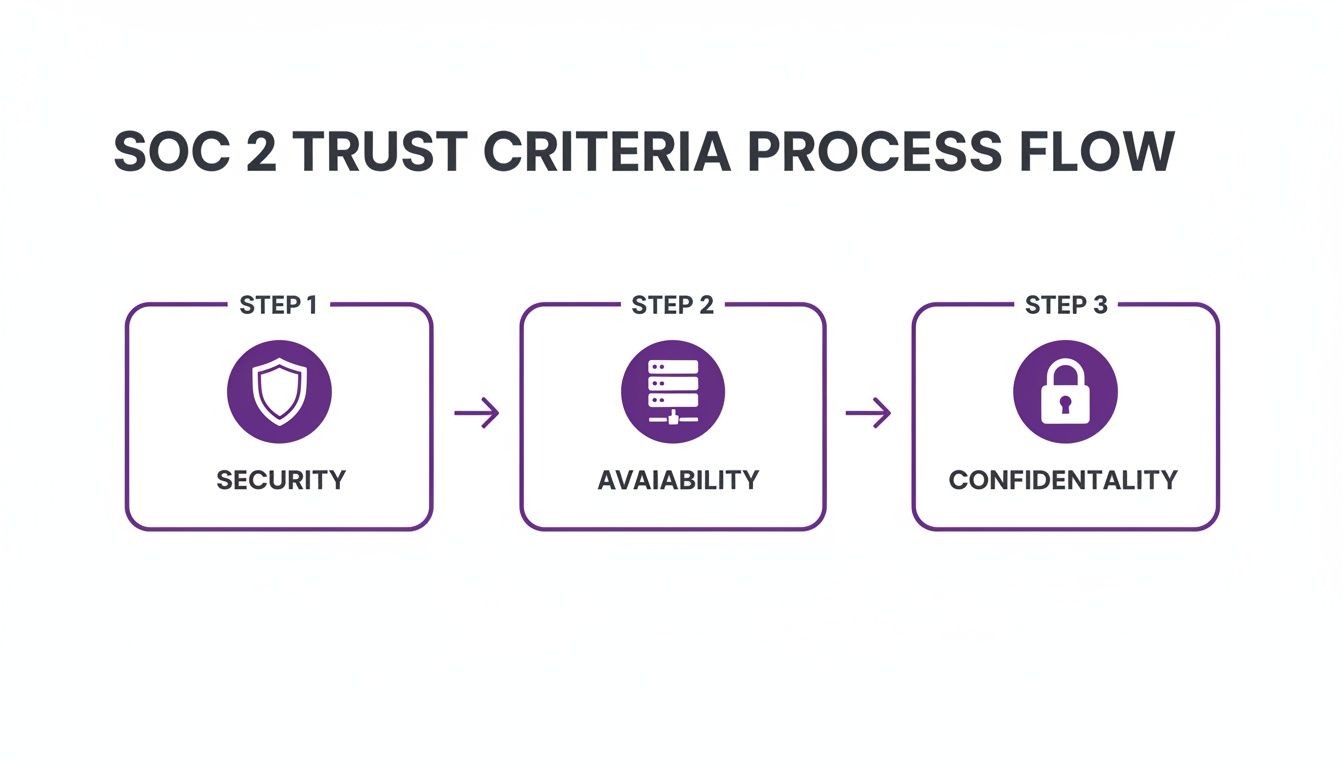
Defining the audit's focus is your first real step, ensuring it aligns with the promises you make to your customers.
Phase 1: Define Your Audit Scope
Before you write a single policy, you must define the scope of your audit. This is the most critical decision, as it sets the direction, cost, and timeline for the entire project. Get this wrong, and you risk a painful, expensive process that may not even meet your customers' needs.
Your scope has two main parts:
- System Boundaries: Clearly identify which parts of your infrastructure, software, people, and data will be audited. For a SaaS company, this almost always includes the production environment handling customer data.
- Trust Services Criteria (TSCs): Select the TSCs relevant to your services. Security is non-negotiable, but adding others like Availability or Confidentiality should be a strategic decision driven by customer requirements.
Phase 2: Conduct a Readiness Assessment
Once your scope is locked in, it’s time for a readiness assessment, or gap analysis. Think of it as a dress rehearsal for the audit. You'll measure your current security posture against the requirements of your chosen TSCs to find every gap between what you do today and what’s needed for a successful audit.
This assessment provides a detailed punch list of everything that needs to be fixed. For many startups, this is when the true scale of the project becomes clear. For example, an assessment might reveal you lack formal vendor management policies or your incident response plan has never been tested.
A thorough readiness assessment prevents nasty surprises during the formal audit. It's far better to discover and fix your own weaknesses on your timeline than for an auditor to find them, which could lead to a qualified opinion or a failed audit.
Phase 3: Remediate Gaps
With your gap analysis complete, it's time for remediation. This is where the heavy lifting happens. Your team will design, document, and implement the controls needed to meet SOC 2 requirements. This is a collaborative effort involving engineering, IT, HR, and legal teams.
Common remediation tasks include:
- Policy Development: Writing and approving key security policies, like an Information Security Policy, Acceptable Use Policy, and Code of Conduct.
- Technical Implementation: Rolling out new tools like multi-factor authentication (MFA), configuring log monitoring, or implementing endpoint detection and response (EDR) solutions.
- Process Formalisation: Documenting and implementing processes for employee onboarding/offboarding, change management, and risk assessments.
- Security Awareness Training: Training all employees on their security responsibilities.
This phase can take anywhere from a few weeks to several months, depending on the complexity of the gaps you uncovered.
Phase 4: Gather Evidence and Undergo the Audit
After remediation is complete and your new controls have been operating for a period (essential for a Type 2 report), you'll start gathering evidence. This involves collecting logs, screenshots, reports, and signed documents that prove your controls are working as designed.
This is also when you'll select a reputable CPA firm to conduct the audit. The auditor will review your evidence and interview key personnel to validate that your controls meet the SOC 2 criteria.
The preparation here is substantial. Many consultancies offer Gap Analysis and Readiness Assessments to support this stage. You can find out more about how expert services support SOC 2 certification in France.
Once the auditor’s fieldwork is done, they’ll issue your final SOC 2 report. With that report in hand, you've officially completed your certification and earned a powerful asset for building trust and closing deals faster.
How Compliance Automation Makes SOC 2 Attainable
For startups and SMBs, the manual road to SOC 2 is a resource-draining nightmare of spreadsheets, tedious evidence collection, and pulling engineers off product development to handle compliance tasks. This isn't just a distraction; it actively stalls your growth.
Fortunately, there’s a smarter way. Compliance automation platforms like Compli.st have transformed this chaotic, manual grind into a streamlined, manageable workflow.
This modern approach puts a SOC 2 report firmly within reach of even the leanest teams. Instead of drowning in spreadsheets, you gain a real-time, centralized view of your entire compliance posture.
Automating Evidence Collection
One of the biggest time sinks in any SOC 2 audit is gathering evidence. Manually taking screenshots and documenting configurations across dozens of systems is tedious and prone to human error. Automation solves this pain point directly.
A modern compliance platform integrates directly into your tech stack. It connects to your cloud providers—like AWS, GCP, and Azure—and the SaaS tools your team uses daily, automatically collecting the proof auditors need.
This means your evidence is always:
- Consistent: Data is gathered uniformly, eliminating variability.
- Timely: Evidence is collected continuously, not in a last-minute scramble before the audit.
- Complete: Automated checks ensure nothing is missed, significantly reducing the risk of audit exceptions.
Streamlining with Pre-Built Templates
Another major hurdle is creating the dozens of policies and procedures required for SOC 2. Writing these from scratch can consume hundreds of hours and often requires expensive legal or consulting fees.
Automation platforms solve this with a library of auditor-approved policy templates mapped directly to SOC 2 controls. Your team can adopt and customize these policies in a fraction of the time, building a solid foundation in days, not months.
By eliminating manual evidence collection and the need to write policies from scratch, automation can reduce the preparation time for a SOC 2 certification by as much as 70%. This frees your team to focus on building a great product.
Ensuring Continuous Compliance
A SOC 2 report isn't a one-and-done project. A Type 2 audit requires you to prove controls are working effectively over several months. After you pass, you must maintain that security posture for renewals and, more importantly, to genuinely protect your customers.
This is where continuous monitoring is essential. Automation platforms constantly check your systems against your security controls. If a setting is misconfigured or a new hire misses security training, you get an immediate alert.
This proactive approach transforms compliance from a periodic fire drill into a manageable, ongoing process. It’s this maturity that auditors love to see. A tool-driven approach streamlines audits and demonstrates a serious commitment to security.
By leveraging automation, startups and SMBs can achieve the same level of security assurance as large enterprises without the massive overhead. While many tools exist, it's critical to find the right fit. You might want to compare some of the 5 best Vanta alternatives to see how different platforms solve the problem. Ultimately, this technology makes a robust SOC 2 certification a realistic—and highly strategic—goal for any ambitious business.
Your Top SOC 2 Questions, Answered
If you’re a founder or tech leader at an SMB, you have practical questions about SOC 2 certification. How much will it cost? How long will it take? Do we really need this? Getting straight answers is the first step to proper planning.
Let's tackle the most common concerns.
How Much Does SOC 2 Certification Cost?
The total investment for a SOC 2 report typically falls between £15,000 and £80,000. The final cost depends on your company's size, the complexity of your systems, and the audit's scope.
Your budget should account for several key expenses:
- Auditor Fees: The largest cost, paid directly to the CPA firm conducting the audit.
- Readiness Tools: Costs for compliance automation platforms that manage evidence and monitor controls.
- Remediation Costs: Potential spending on new security tools, infrastructure changes, or team training to close compliance gaps.
Using a compliance automation platform can significantly reduce the internal hours and resources spent on preparation, making the entire process more cost-effective for startups and SMBs.
How Long Does It Take to Get SOC 2 Certified?
Getting SOC 2 certified is a marathon, not a sprint. Plan for a timeline of three to twelve months from start to finish. The initial readiness and remediation phases—finding and fixing issues—usually take two to six months, depending on your starting point and available resources.
A SOC 2 Type 2 report requires an additional monitoring period of at least three months, though most enterprise clients prefer six to twelve months. After the observation window, the auditor needs another four to six weeks to finalize testing and deliver the report. As French tech firm Koncile recently shared, it's a significant project. You can read more about Koncile’s intensive SOC 2 preparation journey.
Is SOC 2 Legally Required?
No, SOC 2 is not a law or government regulation. It is a voluntary standard created by the AICPA. However, don't let "voluntary" mislead you.
For any B2B SaaS or tech company, SOC 2 has become a commercial necessity for selling to mid-market and enterprise customers. It's the price of admission.
Without a SOC 2 report, you will face significant friction in your sales process. You’ll be buried in lengthy security questionnaires, and some prospects won't engage with you at all. It's simply the cost of building trust and competing for larger deals.
Ready to accelerate your SOC 2 certification and use it to win more deals? Compli.st is an AI-powered platform designed to guide you through the entire process, from readiness assessments and automated evidence collection to answering security questionnaires in minutes. Stop letting compliance be a roadblock. Learn how Compli.st makes SOC 2 attainable for your business.