A SOC 2 Type 2 report is what you get when an independent auditor digs into your company’s security controls. They don't just check if your security plans look good on paper; they verify that those controls have actually been working effectively over a period of time, usually for 6 to 12 months. For startups and SMBs, this report is the master key to unlocking major enterprise deals, proving you’re serious about protecting customer data and moving past endless security questionnaires.
What SOC 2 Type 2 Means for Your Business Growth

You’re in the final stages with a huge new client, and then it arrives: the 200-question security questionnaire. Seeing "SOC 2 Type 2 required" can feel like hitting a brick wall. The sales momentum you built up suddenly grinds to a halt, replaced by a complex, intimidating compliance demand. For a growing business, this moment is a critical fork in the road—do you have the proof to close the deal, or will you be disqualified?
Let's break it down with an analogy. Imagine you’ve designed a high-security vault. A SOC 2 Type 1 report is like having an expert review your blueprints on a single day. They confirm your design is solid—the steel is thick enough, the locks are state-of-the-art, and the alarm systems are correctly planned. It’s a valuable point-in-time snapshot.
A SOC 2 Type 2 report, on the other hand, is completely different. It's like installing security cameras and running them for a whole year. This footage doesn't just show a good design; it proves that the security guards consistently made their rounds, the alarms were always armed, and every single person who entered was properly logged. It's undeniable, operational proof.
Why Enterprise Clients Demand Proof, Not Promises
Big companies aren't just interested in your security blueprint; they need to see it working day in and day out. When they bring you on as a vendor, they're extending their own security perimeter to include you. A data breach at a supplier can cause them catastrophic financial and reputational damage—research shows the global average cost of a breach is now over £3.8 million. Their CISO is on the line.
A SOC 2 Type 2 report shifts the conversation from, "We promise to be secure," to, "We have independently verified proof that our security works, continuously." It’s the gold standard for demonstrating operational effectiveness and the fastest way to get through procurement.
This is why enterprise procurement, legal, and security teams often see a SOC 2 Type 2 report as non-negotiable. It’s how they manage their third-party risk and satisfy their own auditors. Without it, you’re an unknown quantity—a potential weak link in their supply chain that requires painful, manual due diligence.
Turning Compliance into a Competitive Advantage
Getting a SOC 2 Type 2 report isn't just about ticking a box to satisfy one customer. For an ambitious startup, it's a powerful engine for growth. Here's how it can completely change your market position:
- Accelerates Sales Cycles: Instead of getting bogged down in endless security questionnaires, you can hand over your audit report. This satisfies a major procurement hurdle right away and builds immediate trust.
- Unlocks Larger Deals: It gives you the credibility to go after those larger, more lucrative contracts with enterprise clients that were previously out of reach.
- Builds Lasting Trust: The report is a clear signal of a mature security posture. It tells potential customers you’re a reliable, long-term partner who is deeply committed to protecting their data.
- Creates Operational Discipline: The journey to getting audited forces you to implement and document strong internal controls, which has the side effect of making your entire company more efficient, resilient, and secure.
Ultimately, investing in SOC 2 Type 2 is an investment in your company’s future. It demolishes major sales roadblocks, cements your reputation, and lays the trusted foundation you need to scale.
Choosing Your Path: SOC 2 Type 1 vs Type 2
Deciding between a SOC 2 Type 1 and Type 2 report is one of the first big forks in the road on your compliance journey. This isn't just a technicality; it's a strategic business decision that impacts your budget, timeline, and how effectively you can close deals. Getting this right from the start is key to building a smart, progressive path to compliance without wasting resources.
Think of it this way: a SOC 2 Type 1 report is like a snapshot. An auditor comes in, looks at how you’ve designed your security controls at a single point in time, and confirms that, on paper, everything looks right. It essentially answers the question, "Have you designed the right security systems?"
A SOC 2 Type 2 report, on the other hand, is like a movie. The auditor observes your controls operating over a longer period, usually 6 to 12 months. This report proves that your controls don’t just exist—they work consistently, day in and day out. It answers a much more powerful question: "Are your security systems actually effective over time?"
To make the differences crystal clear, let's break them down side-by-side.
SOC 2 Type 1 vs Type 2 At a Glance
| Attribute | SOC 2 Type 1 | SOC 2 Type 2 |
|---|---|---|
| Audit Scope | Design of controls at a specific point in time. | Design and operating effectiveness of controls over a period of time. |
| Duration | A snapshot audit of a single day. | A continuous audit over a 3-12 month period. |
| Purpose | Shows you have the right security controls in place. | Proves your security controls are consistently working as intended. |
| Effort | Lower effort and resource-intensive. | Higher effort, requiring ongoing evidence collection. |
| Customer Trust | Good for initial trust and smaller clients. | The gold standard for enterprise clients and building deep trust. |
As you can see, the choice isn't about which one is "better" in a vacuum, but which one is right for your business right now.
When a Type 1 Report Makes Sense
For many startups, the immediate goal is to unblock a sale. A great deal is on the table, but the customer’s procurement team has put a hard stop on things until they see some kind of security assurance. This is where a Type 1 report shines.
- You Need It Fast: It’s much quicker to get done, often taking just a few weeks of preparation before the audit. That speed can be the difference between closing a deal this quarter or losing it.
- A Gentler Start: A Type 1 audit is less demanding on your team and your wallet, making it a more manageable first step into the world of compliance.
- Checking the Box: It demonstrates a genuine commitment to security and is often enough to satisfy the initial due diligence questions from many mid-market customers.
A Type 1 report is a fantastic stepping stone. It gets you into the conversation, starts building good security habits internally, and lays the groundwork for the more demanding Type 2 audit down the line.
A SOC 2 Type 1 report is your ticket to the dance. A SOC 2 Type 2 report proves you can actually dance all night long. Both have a crucial role depending on your company's stage and immediate goals.
The Strategic Power of a Type 2 Report
While a Type 1 is a great start, the SOC 2 Type 2 report is the undisputed gold standard in security compliance. If your business is targeting large enterprise clients, it’s not just a nice-to-have; it's often a non-negotiable requirement. These bigger customers need absolute proof that their data will be safe with you over the long haul, not just on a single Tuesday.
Investing in a Type 2 audit sends a powerful signal that your company is built for the big leagues. It demonstrates a level of operational maturity and long-term reliability that is essential for earning the trust of major corporations.
Sure, it takes more time and resources, but the return on that investment is huge. It removes security as a sales objection, dramatically shortens due diligence cycles, and positions your company as a secure, trustworthy partner ready to take on the most demanding contracts.
Decoding the Five Trust Services Criteria
At the heart of any SOC 2 audit are the Trust Services Criteria (TSC). Don't let the name fool you; these aren't just technical jargon. Think of them as the five core promises you make to your customers about how you’ll protect their data. Getting these right is the first real step in your SOC 2 journey, as it defines the scope of your audit—and by extension, its cost and complexity.
Every single SOC 2 audit, whether it's a Type 1 or a Type 2, has one non-negotiable starting point: Security. This is the foundation everything else is built on. It covers the essential controls that shield your systems from unauthorised access, prevent data leaks, and stop any damage that could compromise the other promises you make. We're talking about everything from network firewalls and intrusion detection to two-factor authentication.
Once you’ve got Security locked down, you need to choose from the other four criteria. This is where you get to tailor the audit to your actual business, based on the specific commitments you've made to your customers.
Security: The Mandatory Foundation
The Security criterion, often called the Common Criteria, is the bedrock of your SOC 2 report. It's where you prove you have the fundamental protections in place to secure your entire operation. Essentially, it’s about showing you’ve established a solid security posture and have the means to maintain it over time.
For a growing business, this means having well-documented, actionable processes for things like:
- Access Controls: Making sure only the right people can access sensitive information, usually through role-based permissions and reviewed quarterly.
- Change Management: Following a formal process for deploying changes to your production environment to avoid breaking things or introducing vulnerabilities.
- Risk Mitigation: Actively identifying, assessing, and mitigating threats to your systems and putting controls in place to deal with them.
There's a reason this one isn't optional—it holds up all the others. Without a strong security foundation, any claims you make about availability or confidentiality just wouldn't hold water.
Choosing Your Additional Criteria
Beyond Security, your choice of the other four—Availability, Processing Integrity, Confidentiality, and Privacy—comes down to the specific promises you advertise to your customers. There's no point adding criteria that don't apply to your service; it just complicates the audit and drives up the cost.
Choosing your Trust Services Criteria is about aligning your audit with your business model. You are being tested on the specific promises you make, so only include the ones that truly reflect your service commitments to customers.
Let's break down what each of the other criteria really means for your startup.
Availability: Do you guarantee your customers that your service will be up and running when they need it? This is more than just server uptime. It’s about proving you have solid disaster recovery plans, perform regular backups, and have an incident response plan you've actually tested. If your Service Level Agreements (SLAs) promise 99.9% uptime, you absolutely need to include Availability.
Processing Integrity: Does your platform handle critical calculations or transactions for your clients, like financial processing or data analytics? This criterion checks that your system's processing is complete, valid, accurate, and on time. If a customer depends on your output being error-free for their own business, Processing Integrity is a must.
Confidentiality: Do you manage sensitive information that customers have labelled as "confidential"? This could be anything from business plans and intellectual property to financial records. This criterion demands proof that you have strong controls, like end-to-end encryption and tight access policies, to protect that data from getting into the wrong hands.
Privacy: This one is often confused with Confidentiality, but it's different. The Privacy criterion is all about how you collect, use, store, share, and get rid of personally identifiable information (PII). If you handle personal data—names, email addresses, health records—and you make specific commitments in your privacy policy about it, this criterion shows you’re living up to those promises, often in line with frameworks like the GDPR.
Making an informed decision here is a massive step in your SOC 2 Type 2 journey. It helps you focus your efforts, avoid scope creep, and ultimately build a report that genuinely reflects the trust your clients place in you.
Your Step-by-Step SOC 2 Type 2 Audit Roadmap
Getting started with a SOC 2 Type 2 audit can feel like planning a cross-country trek without a map. For startups and SMBs especially, the whole thing can seem daunting, with its complex rules and long timelines. But if you break it down into a clear, actionable roadmap, this massive project becomes a series of much more manageable tasks.
The journey takes you from initial planning all the way through to long-term monitoring. It's not just about passing an audit; it's about methodically building a security posture that you can stand behind. For most lean teams, the real pain point isn't just designing the right security controls, but proving they’ve been working day in and day out for months on end.
As this flowchart shows, the whole process starts with the mandatory Security criterion. From there, you add other criteria like Availability, depending on the specific services and promises you make to your customers.
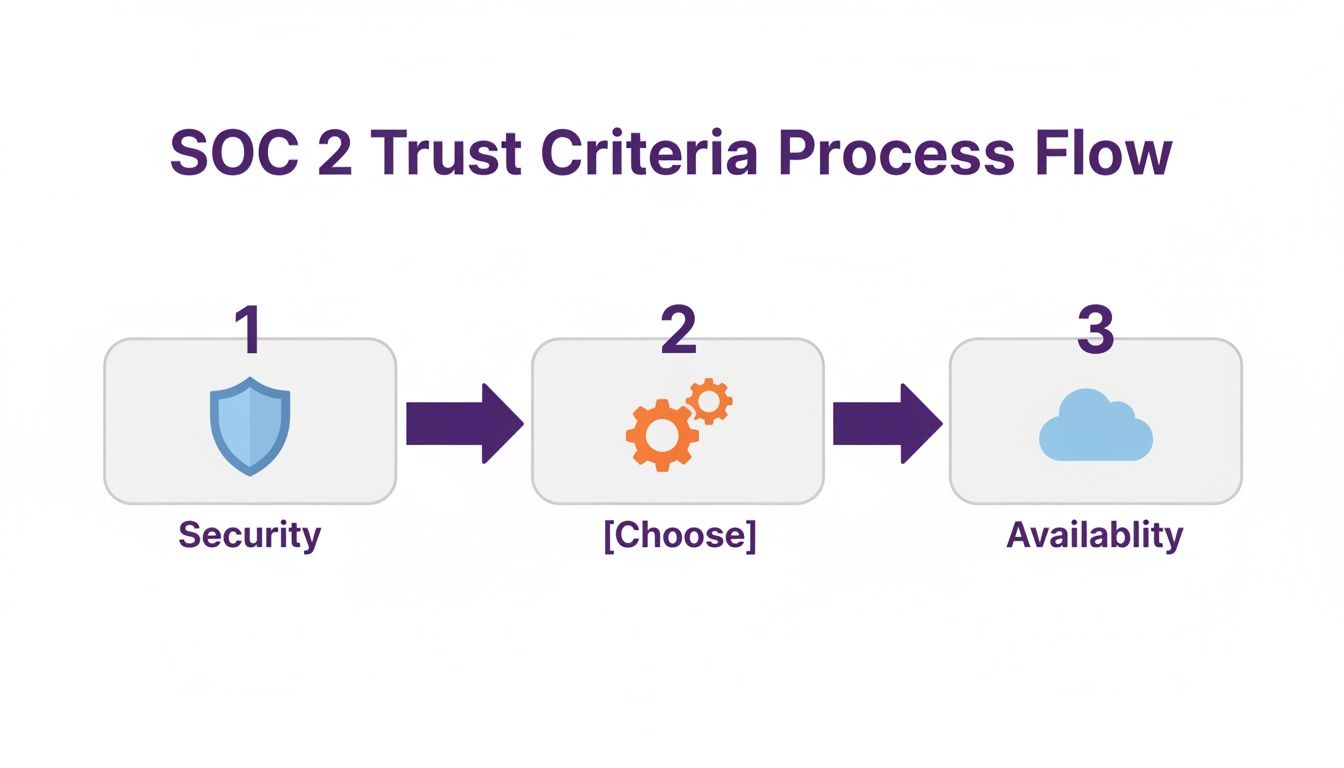
What this really highlights is that your audit is customised to your business. You're only being measured against the commitments you've actually made.
Phase 1: Define Your Audit Scope
First things first, you need to decide what your SOC 2 report is actually going to cover. This means picking the Trust Services Criteria that are truly relevant to your business promises. While Security is non-negotiable, you’ll choose others like Availability or Confidentiality based on what’s written in your customer contracts and service level agreements (SLAs).
Getting the scope right is absolutely critical. If it’s too broad, you’ll add unnecessary cost and complexity. But if it’s too narrow, you might not satisfy the security concerns of the enterprise clients you’re trying to win over.
Phase 2: Conduct a Readiness Assessment
Once your scope is set, the next move is a readiness assessment. Think of this as a pre-audit. It's where you find all the gaps between the controls you have now and what SOC 2 actually demands. It’s like a dress rehearsal that shows you exactly what needs fixing before the main event.
This gap analysis is arguably the most valuable part of the entire process. It hands you a detailed to-do list for remediation, which helps prevent nasty surprises during the real audit and saves you from getting a negative opinion from your auditor.
A thorough readiness assessment transforms the audit from a test you might fail into a verification of work you've already completed. It turns uncertainty into a clear, predictable plan.
Phase 3: Remediate Gaps and Gather Evidence
With your gap analysis in hand, it’s time to get to work. This phase is all about implementing new controls, updating your policies, and documenting absolutely everything. For a Type 2 report, this is also where the heavy lifting of evidence collection really begins.
You’ll need to continuously gather proof that your controls are working effectively over a period of 3 to 12 months. This is often the biggest headache for small teams, who can easily get buried in manual screenshotting and spreadsheet chaos. It's this exact, continuous effort that modern compliance platforms are designed to automate.
For instance, in France, achieving SOC 2 Type 2 is a major differentiator for fintech and SaaS companies. Dfns, a French firm, recently earned a zero-exception SOC 2 Type 2 report from KPMG after a rigorous audit. This achievement shows how French businesses are using the standard not just for compliance, but to prove operational excellence and build rock-solid client trust.
Phase 4: The Official Audit and Observation Period
After you’ve fixed the gaps and have been collecting evidence for a while, you’ll bring in a CPA firm to start the official audit. They will review your documentation and test your controls over the agreed-upon observation period (say, six months).
During this time, your auditor will request samples of evidence to verify that everything has been operating as it should. This is where an automation platform like Compli.st can make things seamless. It centralises all your evidence, making it ready for the auditor's review and turning what could be a frantic scramble into a calm, organised process.
Finally, the auditor issues your SOC 2 Type 2 report. This document becomes your master key to unlocking enterprise deals, speeding through security questionnaires, and proving to the world that your company is a partner they can trust.
Budgeting for Your SOC 2 Type 2 Report
Let's talk about the big question: what is a SOC 2 Type 2 audit actually going to cost? It's easy to focus on the auditor's bill, but that’s just one part of the story. A realistic budget needs to cover the entire journey—from building a solid security programme to proving it works over a long period.
Getting a clear picture of these costs from the start saves a lot of headaches later and makes it easier to justify the investment. Yes, there's an upfront cost, but the ROI is huge. You'll unlock bigger enterprise deals, genuinely improve your security posture, and build operational habits that will serve your business for years to come.
Breaking Down the Total Investment
The total cost of your SOC 2 journey can be split into a few main buckets. For a startup or a small to medium-sized business (SMB), the final number really depends on your company's size, how complex your systems are, and which Trust Service Criteria you’re including in your audit.
Here are the main cost centres you’ll want to map out:
- Readiness and Automation Software: This is your compliance command centre. A platform like Compli.st is designed to automate the painful parts, like collecting evidence and monitoring your controls 24/7, which drastically cuts down on manual work for your engineering team.
- Penetration Testing: You will need an annual penetration test from an independent security firm. It's a non-negotiable control for finding and fixing vulnerabilities before a real attacker does.
- Auditor Fees: This is what you pay the CPA firm to actually perform the audit and issue your final SOC 2 Type 2 report. Their fees will vary based on the scope and complexity of your organisation.
- Employee Training: You’ll need to invest in security awareness training for the whole team. It’s crucial that everyone, not just the engineers, understands their role in keeping customer data safe.
- Internal Team Time: This is the hidden cost that trips up most startups. Your team will be spending a significant amount of time fixing security gaps, managing controls, and responding to auditor requests. This is time not spent building your product.
Realistic Cost Ranges for SMBs
Here in France, the demand for verifiable security is definitely on the rise. A recent report revealed that 76% of French businesses are feeling more pressure from customers and investors to provide proof of compliance, like a SOC 2 Type 2 report. For a small startup, getting ready and completing the audit typically lands somewhere between €10,000 and €25,000. The good news? Automation can make a massive dent in the internal workload. You can dig deeper into the challenges French businesses are navigating in the full Vanta report on the state of trust.
The true cost of SOC 2 isn't just the money you spend; it's also the engineering and management time you commit. Investing in an automation platform is the single most effective way to lower the internal time cost and make the process manageable for a small team.
By bringing all your compliance activities into one place, the whole process becomes far more predictable and affordable. These platforms are built to grow with you, and you can explore pricing for compliance automation tools at https://compli.st/#pricing to see what plan makes sense for your business today. It’s an investment that transforms a painful, manual project into a streamlined, continuous security programme.
How Automation Makes SOC 2 Achievable for SMBs
For most startups and SMBs, the biggest obstacle to a SOC 2 Type 2 report isn’t understanding the controls. It’s the sheer, soul-crushing volume of manual work involved. The traditional route is a painful slog through endless spreadsheets, mind-numbing screenshots, and the constant stress of chasing down colleagues for evidence. This old-school approach isn't just slow; it's a direct path to burnout, human error, and a failed audit.
Think about it. Do you really want your best engineer spending hours every week taking screenshots just to prove a server configuration is still correct? Or your CTO manually digging through user access logs from a dozen different apps to get ready for an audit? That kind of manual grind doesn't just suck up your most valuable people's time; it leaves you with a compliance programme that’s fragile, inconsistent, and always playing catch-up.
The Modern, Automated Approach
Thankfully, there's a much better way. Modern compliance platforms have put enterprise-level security within reach for even the leanest of teams. These tools act like a central hub for your entire security setup, plugging directly into the systems you already rely on—your cloud provider (AWS, Azure, GCP), HR software, code repositories, and project management tools.
This creates a powerful, always-on monitoring system. Instead of someone having to hunt for evidence, the platform gathers it automatically, 24/7. Rather than finding a critical misconfiguration in the middle of an audit, you get an alert the second something goes wrong. Everything is neatly organised, timestamped, and mapped directly to the right SOC 2 controls, all ready for your auditor to review.
Automation turns SOC 2 compliance from a disruptive, all-hands-on-deck project into a calm, continuous process. It shifts your security posture from a state of periodic panic to one of permanent, provable readiness.
This is a fundamental change. It gives small teams the power to achieve a level of security that used to require a dedicated compliance department.
Unlocking Efficiency and Continuous Trust
The benefits of automating your SOC 2 Type 2 evidence collection are huge, and you'll feel them right away. Here’s what that looks like in the real world for a startup:
- Hundreds of Hours Saved: Automation gets rid of the most tedious manual tasks. This frees up your engineering team to focus on what they do best: building your product, not getting bogged down in compliance paperwork.
- Reduced Human Error: Let's be honest, manual evidence collection is a recipe for mistakes. An automated system ensures everything is complete, consistent, and correctly formatted, which seriously lowers the risk of a failed audit.
- A Real-Time Security View: You get a live dashboard showing the health of your security controls. This constant visibility lets you manage risk proactively, not just scramble to fix things before an audit.
Global giants like SAP showcase the high standards of a SOC 2 Type 2 audit, which often involves a full year of operational proof across Security, Availability, and Confidentiality. For French companies operating within a global supply chain, this detailed, ongoing evidence is quickly becoming the minimum requirement. SAP's compliance work is a great example of how to build stakeholder trust, demonstrating how SOC 2 can be woven into European corporate governance.
Platforms such as Compli.st give you the toolkit to meet this high bar without the headache. By making compliance an automated process that hums along in the background, your business can confidently prove its security, close bigger deals, and build the deep trust you need to grow.
Common SOC 2 Type 2 Questions Answered
Even with a clear plan, getting into the nitty-gritty of a SOC 2 Type 2 audit always brings up some practical questions. Let's face it, the process can feel overwhelming. Getting straight, actionable answers is the best way to move forward with confidence. Here are the most common questions we hear from startups.
How Long Is a SOC 2 Report Valid?
This is probably the number one question people ask. The short answer is that a SOC 2 report is really only considered fresh for one year. Once you pass that 12-month mark, your customers and prospects will likely see it as outdated because it no longer reflects how your controls are operating today.
Think of it as an annual health check-up for your security posture. You'll want to get into a rhythm of yearly audits to maintain continuous compliance. This avoids any awkward gaps between reports and shows everyone you're serious about security all year round, not just for a one-time audit. It also keeps your best sales asset polished and ready to go.
What Happens If an Auditor Finds an Exception?
Hearing the word "exception" can definitely make your heart skip a beat, but it doesn't mean you've failed the audit. An exception is simply a finding where a control didn't work exactly the way you said it would. A classic example is when a former employee’s access wasn't removed within the 24-hour timeframe your own policy requires.
What really matters is how you respond. The auditor will document the exception in the report, and you'll get a chance to provide a management response. This is your opportunity to explain what happened, why it happened, and—most importantly—what steps you've taken to make sure it doesn't happen again. Being upfront and showing you have a solid process for fixing issues can actually strengthen a customer's trust in you.
An auditor exception isn't a failure; it's a finding. A well-documented management response that shows you've addressed the root cause proves your risk management process is effective and working as intended.
How Can I Leverage My SOC 2 Report in Sales?
Your final SOC 2 Type 2 report is so much more than a box-ticking exercise; it's a powerful tool for your sales team. Instead of getting bogged down for weeks filling out lengthy security questionnaires, you can often share the report (under an NDA, of course) and answer most of a prospect's questions in one go.
Here are a few actionable ways to put it to work:
- Build Trust Proactively: Don't wait to be asked. Mention your SOC 2 compliance on your website, in security documentation, and in sales pitches to get ahead of security concerns before they even come up.
- Speed Up Security Reviews: The security review stage can be a major deal-killer. Handing over a comprehensive report can turn a month-long back-and-forth into a much shorter, smoother conversation.
- Answer Questionnaires Faster: Your report is a goldmine of verified information. Your team can pull directly from it to answer specific questions with confidence and accuracy, or use a tool to automate the process.
For more insights on managing compliance and building trust, you can explore additional resources on the Compli.st blog.
Ready to transform your security questionnaires from a roadblock into a sales accelerator? Compli.st uses AI to complete security questionnaires in minutes, helping you build trust and close deals faster. See how at https://www.compli.st.